
For two decades, business software procurement has relied on a familiar script: the per-seat Software-as-a-Service (SaaS) subscription. Finance understands it, procurement negotiates it, and IT uses it to forecast annual operating budgets.
As organizations move from basic writing assistants to autonomous operational workflows, that pricing model falls apart.
An automated workflow does not sit at a desk or work an eight-hour shift. It might stay idle for days, then process millions of data tokens in a three-minute burst to resolve a supply chain bottleneck or reconcile ledgers.
Evaluating autonomous software through monthly seat licenses creates an operational mismatch. It hides true processing costs, locks workflows into closed ecosystems, and makes calculating real return on investment difficult. Capturing measurable business leverage requires shifting from flat seat subscriptions to tracking compute-to-value ratios.
What is Compute-Based Unit Economics in AI Operations?
Compute-based unit economics is an operational model that measures the direct cost of machine processing (token inference, API calls, and server runtime) against the measurable business output of an automated task. This approach replaces monthly per-seat licensing with a variable cost-per-completed-workflow model.
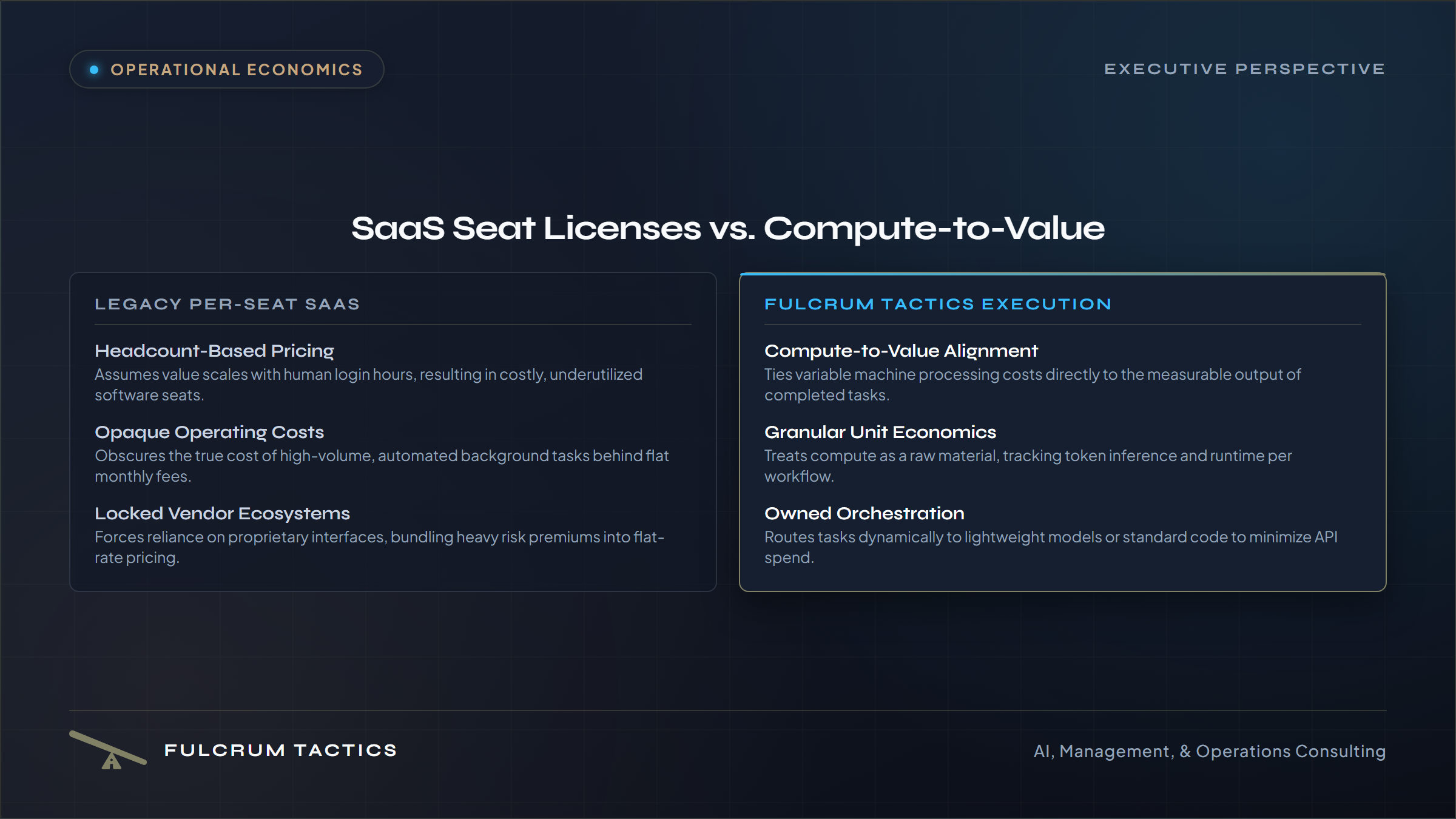
SaaS Seat Licenses vs. Compute-Based Unit Economics
┌─────────────────────────┬────────────────────────────┬────────────────────────────┐
│ Dimension               │ Per-Seat SaaS Model        │ Compute-to-Value Model     │
├─────────────────────────┼────────────────────────────┼────────────────────────────┤
│ Pricing Basis           │ Fixed monthly fee per user │ Variable cost per workflow │
│ Resource Alignment      │ Assumes human login hours  │ Aligns with compute volume │
│ Infrastructure Control  │ Locked to vendor interface │ Owned orchestration layer  │
│ Cost Attribution        │ Overhead department line   │ Direct unit cost per task  │
└─────────────────────────┴────────────────────────────┴────────────────────────────┘
Why Does the Per-Seat SaaS Model Break Down for Autonomous Workflows?
The seat-license model assumes business value scales with human headcount: 100 customer service reps require 100 software seats.
Autonomous workflows break that assumption for two main reasons:
- Unpredictable Consumption Spikes: A human operator reads and writes a few thousand words a day. An automated workflow reading invoices and matching database records can process that volume in seconds. To stay profitable, vendors bundle heavy risk premiums into flat-rate pricing to cover their heaviest users.
- Disconnected User Value: When automated scripts run continuous background tasks—such as matching purchase orders or auditing compliance logs—no individual user is sitting at a terminal. Charging a flat monthly fee per supervisor obscures the actual cost of running the workflow.
Sticking to per-seat pricing means paying for unused software access while remaining blind to the true cost of high-volume tasks.
How Do You Calculate the Compute-to-Value Ratio?
To manage automated systems effectively, treat compute as a variable raw material. Evaluate every step in an automated process by its Compute-to-Value Ratio: the direct cost of the compute required versus the labor hours saved or financial errors prevented.
Compute-to-Value Ratio = (Cost of Model Tokens + Cloud Compute) / (Labor Cost Saved + Rework Prevented)
For instance, if a complex reasoning step uses an advanced frontier model costing $2.00 in compute to catch a billing discrepancy that would otherwise take a finance analyst 30 minutes ($25 in burdened labor cost) to reconcile, the return is roughly 1:12.
Conversely, running expensive multi-model reasoning loops just to reformat routine internal emails creates negative ROI. Tracking metrics at the workflow level allows teams to route each task to the most cost-effective tool available.
What are the 3 Pillars of an Owned Workflow Architecture?
Operating with compute-based discipline requires decoupling your workflow logic from third-party wrappers:
Workflow Architecture:
[Raw Input] ──> [1. Deterministic Python Prep] ──> [2. Tiered Model Routing] ──> [3. Hard Spend Ceilings] ──> [Verified Output]- Deterministic Data Preparation First: Run standard Python scripts to handle data extraction, database joins, and validation checks before sending any data to an AI model. Using generative models to format tables or clean CSV files wastes budget on simple computing tasks.
- Tiered Model Routing: Use lightweight, specialized models for 80% of routine classification, extraction, and drafting tasks. Reserve large, proprietary models strictly for complex reasoning or handling unstructured edge cases.
- Hard Spend Caps and Rate Limits: Set hard dollar ceilings and hourly execution caps in code. Automated kill switches prevent accidental loops or oversized file uploads from generating unexpected API charges.
How Can Leaders Transition from Seat Licenses to Owned Workflows?
Transitioning from third-party subscriptions to owned workflow automation follows three practical steps:
- Audit current software add-ons: Review your existing software stack to identify subscriptions that are simply basic interfaces over standard APIs. Compare what you pay per seat against direct API or private hosting costs.
- Own the workflow orchestration: Build or implement modular, open-source orchestration pipelines so your business logic remains independent of any single model provider.
- Adjust procurement targets: Shift procurement discussions from bulk seat discounts toward scalable cloud compute, dedicated GPU capacity, and high-volume API agreements.
Treating automated workflows as capital assets with clear unit economics allows you to scale high-margin processes while deprecating low-value tools.
🔗 Ingested Source Material & References
- [McKinsey Insights] Governing AI with intention in the social impact sector
As AI adoption grows, mission-driven organizations must weigh how to adopt new capabilities without sacrificing the trust central to every donor relationship, constituent served, and mission pursued....
- [McKinsey Insights] Driving value with an investor mindset
Long-term value creation is foundational to building strong companies and economies, yet many leaders struggle to ensure that well-conceived, well-executed strategies receive full recognition from inv...
- [McKinsey Insights] How premium leisure travel is rewriting airline economics
Business class isn’t just for corporate travelers anymore. Affluent vacationers are splurging on premium cabins—and becoming one of the biggest drivers of airline profitability....
- [McKinsey Insights] Putting innovation—and patients—in focus: A conversation with Astellas Pharma CEO Naoki Okamura
The Tokyo-based biopharmaceutical company is accelerating its pipeline by innovating at the intersection of biology, modality, and disease....
- [McKinsey Insights] How instant payments are transforming the financial landscape
Lessons from markets around the world can help commercial payments players keep pace with a rapidly evolving environment....