
Bottom Line Up Front (BLUF)
Proprietary document parsing APIs charge between $0.015 and $0.05 per page while introducing unversioned extraction drift into production data stores. Engineering teams waste hundreds of hours patching custom regex filters when black-box endpoints update their internal heuristics. By running local Model Context Protocol (MCP) servers with strict JSON schema validation, operators strip out recurring per-page API taxes, guarantee deterministic output contracts before payloads reach database state, and isolate extraction errors directly at the pipeline perimeter.
The Hidden Costs of Black-Box Document Parsers
Most automated document workflows rely on commercial document extraction APIs or opaque multimodal wrappers. On the surface, the proposition appears simple: post a PDF to an HTTPS endpoint and receive parsed key-value pairs in return.
In production, this architecture breaks down across three operational vectors:
- Unit Economics at Scale: An organization handling 40,000 multi-page vendor bills, bills of lading, or grant reports per month pays between $600 and $2,000 monthly for standard OCR and basic field parsing. If those documents require multimodal reasoning or specialized table extractors, the cost climbs past $4,000 every month. That is a recurring operational expenditure paid to proprietary vendors for commodity tasks.
- Schema Instability and Model Drift: Commercial parsers frequently alter their underlying models or extraction heuristics without notice. An invoice parser that returned
tax_amountas an integer on Tuesday may begin returning a string with currency symbols on Wednesday. Because the transformation logic is hidden inside a vendor black box, these breaks occur downstream in the relational database write phase, corrupting tables or stalling pipelines. - Context Window Contamination: Shoving raw, unparsed document dumps straight into an LLM context window exhausts token limits and forces the model to perform OCR, structural alignment, and data transformation simultaneously. This approach degrades inference accuracy and inflates input token costs.
When an ingestion pipeline fails silently because a parser dropped a line item or altered a schema, engineering teams spend high-cost developer sprints building defensive formatting wrappers. The fix is not to write more glue code around closed APIs. The fix is to shift extraction and validation into an open, protocol-governed pipeline.
The Role of Model Context Protocol in Extraction Architecture
The Model Context Protocol (MCP) establishes an open standard for how client applications, local orchestration environments, and language models exchange context and execute tool calls. Instead of treating document parsing as a proprietary remote cloud service, an engineering team can run an MCP server locally or within a private virtual network.
Recent production moves demonstrate this shift toward standardized protocol interfaces. DocuSign recently published an open MCP server to expose document management and execution primitives directly to agentic environments, bypassing closed, point-to-point API configurations.
In a document ingestion pipeline, an MCP server standardizes three core capabilities:
- Resource Exposure: Serving raw file buffers, local disk paths, or object storage blobs through a unified URI scheme (
file://,s3://). - Tool Execution: Encapsulating discrete local binaries (such as
pdfplumber,MuPDF, or containerized OCR workers) into structured tools that an LLM client can call with predictable parameters. - Strict Context Boundary Control: Enforcing deterministic limits on what data passes into inference memory, preventing unbounded token dumps.
By placing an MCP server between unstructured input and the language model, you separate text extraction from semantic normalization. The MCP server reads the file and handles the layout mechanics deterministically. The LLM handles only the structural extraction, guided strictly by an MCP tool schema.
[Raw Document: PDF/TIFF]
         │
         ▼
[Local MCP Server] ─── (Runs MuPDF / Layout Analysis / OCR)
         │
         ▼
[MCP Tool Call with Strict JSON Schema]
         │
         ▼
[Local / Private LLM Inference]
         │
         ▼
[Pydantic / Zod Runtime Validation]
         │
    ┌────┴────────────┐
    ▼                 ▼
[Pass: PostgreSQL]  [Fail: Dead-Letter Queue (DLQ)]
Structural Schemas Before Context Windows
A production ingestion pipeline must enforce schema validation before any extracted data touches production memory or downstream applications.
When an LLM extracts data through an MCP tool call, the tool definition must dictate the schema down to primitive types, exact regex formats, and array structures. The client must never accept a raw string response from a model and hope it contains valid JSON.
Consider this standard Pydantic schema used by an MCP document ingestion worker handling supplier invoices:
from pydantic import BaseModel, Field
from typing import List
from decimal import Decimal
from datetime import date

class InvoiceLineItem(BaseModel):
    description: str = Field(..., min_length=1)
    quantity: Decimal = Field(..., gt=0)
    unit_price: Decimal = Field(..., ge=0)
    total_amount: Decimal = Field(..., ge=0)

class ValidatedInvoicePayload(BaseModel):
    vendor_tax_id: str = Field(..., regex=r"^\d{2}-\d{7}$")
    invoice_number: str = Field(..., min_length=3, max_length=50)
    invoice_date: date
    subtotal: Decimal = Field(..., ge=0)
    tax_amount: Decimal = Field(..., ge=0)
    total_due: Decimal = Field(..., gt=0)
    line_items: List[InvoiceLineItem] = Field(..., min_items=1)
The MCP server exposes this schema as a tool: record_invoice_data. When the inference engine parses the document layout provided by the MCP resource reader, it can only return data by invoking this specific tool.
If the model hallucinates a field, omits a line item total, or formats a date as MM/DD/YYYY instead of YYYY-MM-DD, the Pydantic runtime rejects the payload instantly at the client level. The failed payload never reaches your PostgreSQL database or your ERP system.
Isolating Failure Modes with Dead-Letter Queues
Closed document APIs handle unexpected input through vague HTTP error codes or, worse, by returning empty fields with a 200 OK status. This forces operations teams to run manual data reconciliations after bad data has already contaminated production storage.
A deterministic pipeline built on MCP treats parsing errors as deterministic pipeline states. When an ingestion job fails validation, the system executes an automated containment workflow:
- Schema Rejection: The MCP client catches the validation error from the tool execution layer.
- Deterministic Retry: The client passes the exact validation error back to the model context for a single correction pass. For example:
"ValidationError: invoice_date does not match YYYY-MM-DD". - Dead-Letter Routing: If the second pass fails, the raw document, the layout extraction dump, and the model's failed tool-call payload are written to a Dead-Letter Queue (DLQ) in local storage or an S3 bucket.
- Human-in-the-Loop Review: An operations operator inspects the DLQ record using an internal tool interface. The operator corrects the field, and the payload is re-queued into the standard write pipeline.
This workflow guarantees that your core databases ingest zero unvalidated records. Pipeline failures stop being silent bugs discovered by accountants weeks later; they become structured events handled immediately by operational workflows.
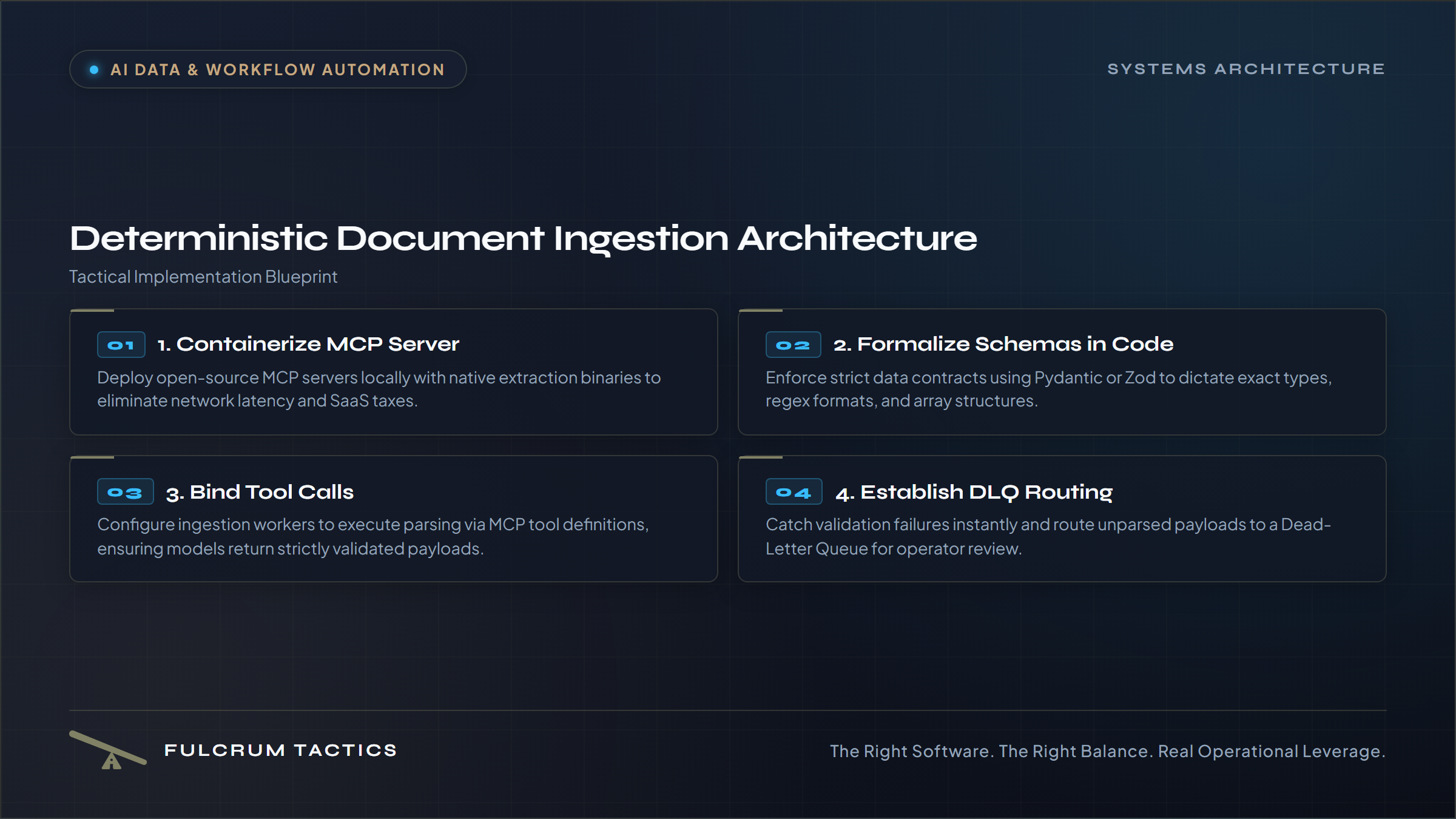
Tactical Implementation Blueprint
Migrating from a SaaS parsing API to a local MCP ingestion architecture requires four discrete engineering steps:
- Step 1: Containerize the MCP Server. Package an open-source MCP server with local PDF extraction libraries (
pdfplumberfor text-native documents,Tesseractor an ONNX-optimized OCR engine for flat scans). Run this container on the same network or host machine as your workflow orchestrator to eliminate network latency. - Step 2: Formalize Schemas in Code. Define explicit data contracts for every document type your business processes. Write these schemas using Pydantic (Python) or Zod (TypeScript). Store these definitions in a shared repository so ingestion tools and application databases reference the same truth.
- Step 3: Bind Tool Calls to Inference Clients. Configure your orchestration client (e.g., an internal Python worker or workflow engine) to connect to the local MCP server over standard input/output (stdio) or Server-Sent Events (SSE). Expose the parsing schemas strictly as callable tools.
- Step 4: Establish the DLQ and Metric Tracking. Set up automated tracking on three primary health metrics: validation pass rate on first attempt, retry success rate, and DLQ drop rate. If your DLQ drop rate exceeds 3% on a specific document category, the layout extraction rules or the schema definitions require adjustment.
Operating this architecture gives your engineering team full control over the ingestion boundary. You stop paying per-document rents to external platform vendors, eliminate unexpected upstream schema breaks, and keep production storage clean through deterministic, code-level enforcement.
🔗 Ingested Source Material & References
- [MIT Technology Review - AI] Architecting memory and storage in the AI era
> The era of AI inference has arrived. Imagine a healthcare system analyzing millions of data points in real time to accelerate life-saving medical research, or an intelligent assistant instantly resolving thousands of com...
- [Small Business Trends] Salesforce Unveils Claudeforce: Transforming Customer Experiences
> Discover how Salesforce's latest innovation, Claudeforce, is revolutionizing customer experiences by leveraging cutting-edge technology and data-driven insights. Explore the transformative features and benefits that will...
- [Small Business Trends] DocuSign Unveils Open MCP Server, Enhancing AI Integration for Enterprises
> Discover how DocuSign's new Open MCP Server is revolutionizing AI integration for enterprises, streamlining workflows, and enhancing document management capabilities. Explore the features and benefits that empower busine...
- [Practical Ecommerce] Do We Still Need Google Disavow?
> Yes, Google's Disavow tool remains useful for manual, link-related penalties.
The post Do We Still Need Google Disavow? appeared first on Practical Ecommerce....
- [Practical Ecommerce] The Race to Own AI Shopping
> Will shoppers use AI mostly on external platforms, or on-site directly with merchants?
The post The Race to Own AI Shopping appeared first on Practical Ecommerce....