
Bottom Line Up Front (BLUF)
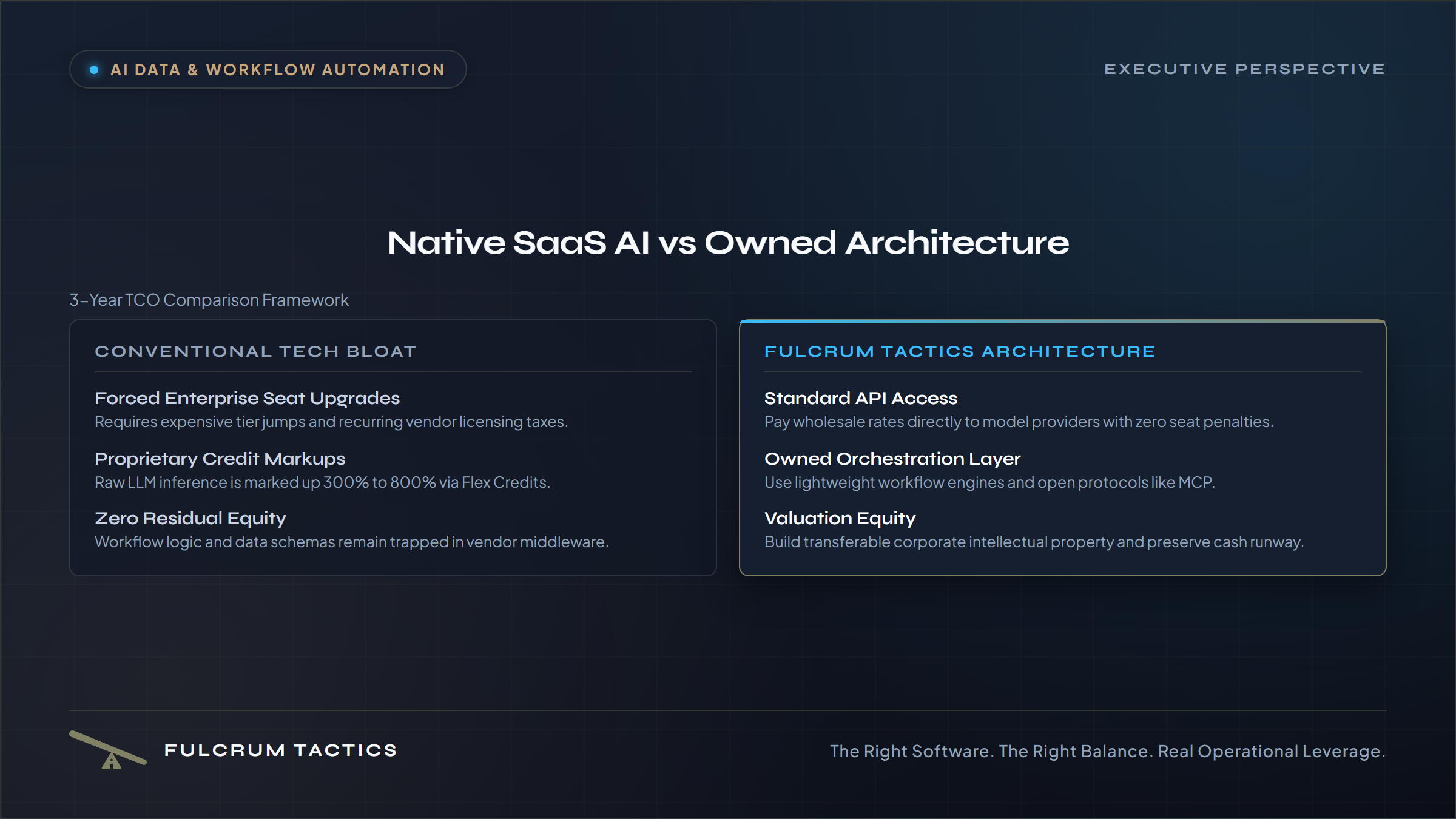
Bundling artificial intelligence into legacy SaaS platforms like Salesforce promises turnkey automation, but introduces a severe margin tax for SMBs. Platform giants wrap raw LLM inference in proprietary consumption credits and forced enterprise seat upgrades, marking up base compute costs by 300% to 800%. To protect cash runway and maintain EBITDA, mid-market founders must decouple data models and workflow execution from application vendors. Implementing owned orchestration architectures using open standards like Model Context Protocol (MCP) lowers 3-year total cost of ownership (TCO) while securing long-term software assets.
The Economics of the Native AI Markup
SaaS platform vendors face an existential challenge: core products like CRMs, ERPs, and e-signature tools are mature, and seat-based license growth has slowed. Their response is embedding foundation models directly into legacy workflows under branded umbrellas like Claudeforce or Agentforce.
For mid-market companies, buying these native features appears sensible. It eliminates custom integration work and provides instant user interface components. However, the financial trade-off is asymmetric.
Application vendors convert variable compute into proprietary unit currencies like "Flex Credits" or "Agent Credits." When an operational team executes an automated pipeline inside a legacy platform:
- The vendor routes the request through their proprietary Retrieval-Augmented Generation (RAG) pipeline.
- They call a foundation model API behind the scenes.
- They apply a steep markup to cover platform overhead and corporate profit targets.
A workflow requiring 2,000 tokens of context and a 500-token completion costs approximately $0.004 on direct model provider APIs. Inside a native enterprise platform, that same interaction consumes fixed vendor credits equivalent to $0.08 to $0.25. At 50,000 monthly operational workflows, this pricing differential represents an extra $45,000 to $140,000 in annual operating expense for identical underlying output.
Context Lock-In and Storage Architecture
The financial risk extends beyond token markups into data architecture. Efficient AI execution depends on context management: real-time memory retrieval, structured data schemas, and clean state persistence across step sequences.
When you build automation inside a vendor's native AI layer, your memory architecture becomes tied to their database schemas. The platform controls how context is indexed, which vectors are cached, and how historical interactions inform future actions.
This introduces two distinct operational vulnerabilities:
- Uncontrolled Token Inflation: Native RAG architectures frequently inject bloated background context into model prompts to ensure system compliance, forcing your account to burn credits on unnecessary input tokens.
- Data Hostage Dynamics: If you decide to migrate away from a platform, your workflow logic, prompt templates, and custom fine-tuning data remain locked within their proprietary middleware.
Direct control over your inference pipeline allows you to architect custom vector indices, optimize context windows, and store execution logs in owned data warehouses such as PostgreSQL with pgvector or Snowflake. Controlling data context directly lowers compute costs while preserving core operational IP.
Decoupling Strategy: Open Protocols and Owned Workflows
Mid-market operators do not need to choose between expensive native vendor AI and fragile custom-coded integrations. The emergence of open integration standards, such as open implementations of the Model Context Protocol (MCP), provides a pragmatic third option.
MCP establishes an open server standard that lets foundation models interact with external data sources and business tools without requiring bespoke middleware for every vendor. Enterprise tools like DocuSign are adopting open MCP servers, allowing external AI systems to query documents and trigger workflows directly.
By building an owned workflow layer using open protocols, your architecture separates three distinct tiers:
- Data Systems of Record: Your CRM, ERP, and document storage remain standard repositories.
- Owned Orchestration Layer: Lightweight workflow engines (such as n8n, Temporal, or custom Python services) manage logic, state, and security rules.
- Pluggable Inference Tier: Direct connections to model APIs (Anthropic, OpenAI, or self-hosted open-weights models like Llama) process requests at wholesale rates.
This separation eliminates vendor markup and gives your engineering team complete control over routing tasks to the cheapest, most efficient model suitable for each specific work unit.
Comparing 3-Year TCO: Native vs. Owned Architecture
Evaluating AI investments requires analyzing 36-month capital allocation. Below is a cost comparison for a $15M ARR business executing 75,000 monthly automated operations across sales, customer service, and contract administration.
| Cost Line Item | Native SaaS AI Layer | Owned Orchestration + Direct API |
|---|---|---|
| Seat Upgrades / Tier Tax | $36,000 / year (Required Enterprise Tiers) | $0 (Standard API access) |
| Compute / Credit Consumption | $112,500 / year ($0.125 avg per execution) | $13,500 / year ($0.015 avg per execution) |
| Initial Build & Setup | $10,000 (Vendor configuration) | $35,000 (One-time CapEx implementation) |
| Ongoing Maintenance | $12,000 / year (Vendor release updates) | $15,000 / year (Internal pipeline maintenance) |
| 3-Year Total Cost | $493,500 | $120,500 |
| Asset Status | Zero residual equity (SaaS tax) | Owned corporate intellectual property |
The owned approach preserves $373,000 in cash runway over three years. That capital goes straight to EBITDA, funding additional product development or expanding sales coverage rather than subsidizing vendor margins.
Executive Action Protocol
To eliminate silent compute drain and maintain margin discipline, SMB leadership should execute a four-step remediation protocol:
- Audit Existing Platform AI Billing: Mandate a line-item review of all SaaS spend. Identify hidden consumption fees, mandatory enterprise tier upgrades, and token credit packages attached to native AI functionality.
- Freeze Proprietary Workflow Builds: Put a moratorium on building custom agentic workflows inside closed SaaS platforms. Require vendor solutions to justify why open API integrations cannot achieve the same operational outcome.
- Deploy Standardized Open Middleware: Adopt open protocol servers (such as MCP endpoints) to bridge internal databases with LLM providers. Ensure data context rules stay within company-controlled databases.
- Capitalize Internal Automation Assets: Structure automation investments as clear CapEx projects that yield owned software assets. Quantify ROI based on direct unit cost reduction and EBITDA preservation.
Owning your operational workflows secures your cash runway and ensures your company builds transferable valuation equity in the AI era.
🔗 Ingested Source Material & References
- [MIT Technology Review - AI] Architecting memory and storage in the AI era
> The era of AI inference has arrived. Imagine a healthcare system analyzing millions of data points in real time to accelerate life-saving medical research, or an intelligent assistant instantly resolving thousands of com...
- [Small Business Trends] Salesforce Unveils Claudeforce: Transforming Customer Experiences
> Discover how Salesforce's latest innovation, Claudeforce, is revolutionizing customer experiences by leveraging cutting-edge technology and data-driven insights. Explore the transformative features and benefits that will...
- [Small Business Trends] DocuSign Unveils Open MCP Server, Enhancing AI Integration for Enterprises
> Discover how DocuSign's new Open MCP Server is revolutionizing AI integration for enterprises, streamlining workflows, and enhancing document management capabilities. Explore the features and benefits that empower busine...
- [Practical Ecommerce] Do We Still Need Google Disavow?
> Yes, Google's Disavow tool remains useful for manual, link-related penalties.
The post Do We Still Need Google Disavow? appeared first on Practical Ecommerce....
- [Practical Ecommerce] The Race to Own AI Shopping
> Will shoppers use AI mostly on external platforms, or on-site directly with merchants?
The post The Race to Own AI Shopping appeared first on Practical Ecommerce....