
In middle-market acquisitions, signing a Letter of Intent (LOI) marks a sharp shift in deal leverage. Before the LOI, the seller sets the pace with competitive tension and controlled information. The moment that document is signed, exclusivity kicks in, competitive pressure vanishes, and the buyer's Quality of Earnings (QofE) team digs into every corner of the business.
This is where the "diligence dip" hits.
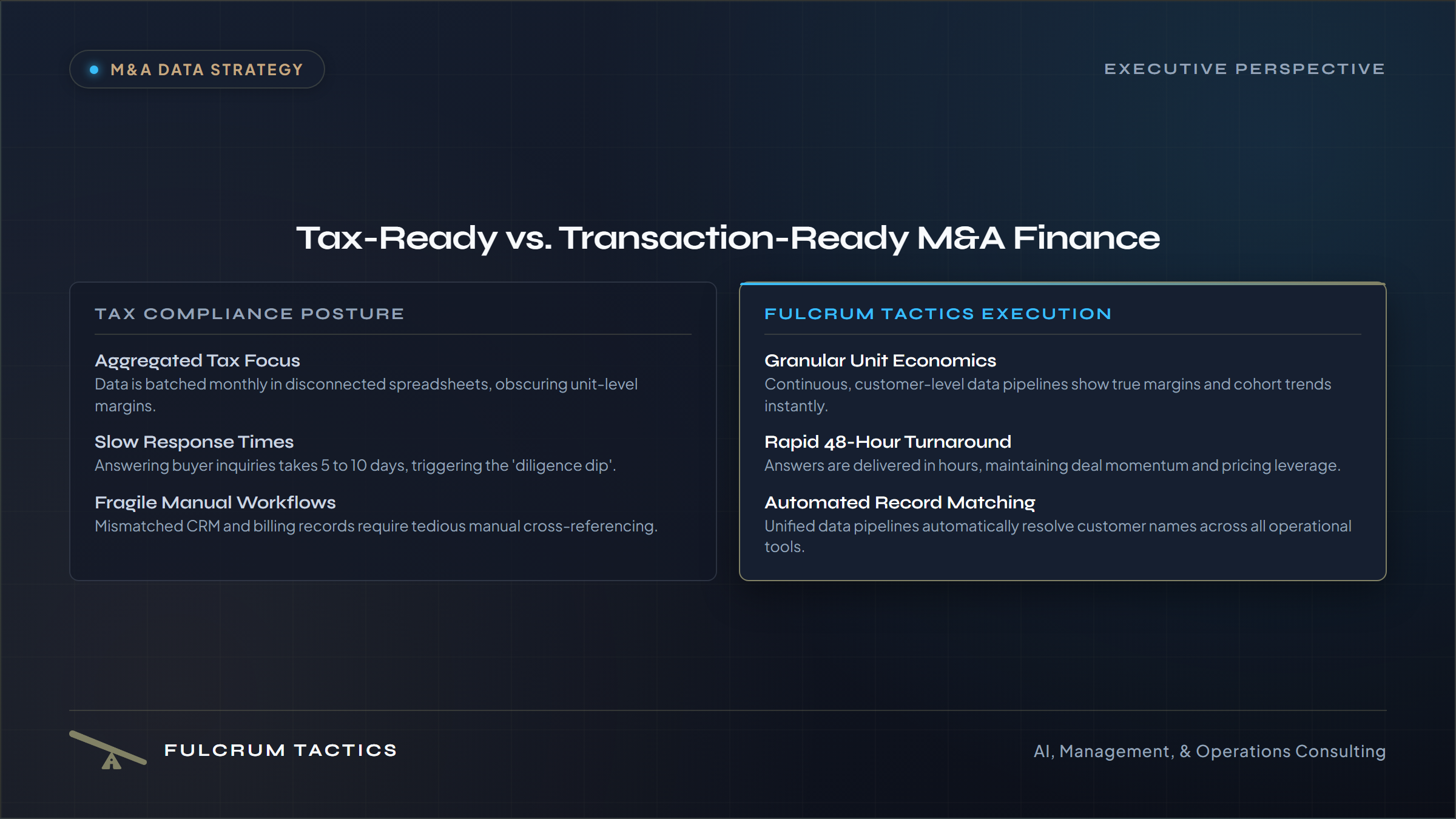
Most growing companies build finance workflows for annual tax filing rather than transactional audits. Tax reporting focuses on aggregated, backwards-looking numbers. Buy-side diligence demands real-time, unit-level detail. When an acquisition team asks for customer-by-customer margin walks, cohort retention, or SKU-level revenue trends, internal finance teams often scramble through disjointed spreadsheets.
That scramble creates delays. Delays create skepticism. Skepticism leads to renegotiated prices, unfavorable deal terms, or broken transactions. Protecting company valuation requires replacing manual spreadsheet audits with automated, transaction-ready data workflows long before going to market.
What is the "Diligence Dip" in M&A Transactions?
The diligence dip is a sudden loss of deal momentum and pricing power that occurs when a seller takes longer than 48 hours to answer buy-side financial inquiries. When basic customer and margin data cannot be quickly verified, buyers assume operational disorganization or hidden liabilities, resulting in valuation haircuts and renegotiated terms during exclusivity.
Tax Reporting vs. Transactional Diligence
┌─────────────────────────┬────────────────────────────┬────────────────────────────┐
│ Attribute               │ Tax Compliance Posture     │ Transaction-Ready Posture  │
├─────────────────────────┼────────────────────────────┼────────────────────────────┤
│ Data Granularity        │ Aggregated monthly totals  │ Unit-level & customer-level│
│ Reporting Cadence       │ Monthly / Quarterly batch  │ Continuous / Real-time     │
│ System Integration      │ Disconnected silos (Excel) │ Unified automated pipeline │
│ Inquiry Response Time   │ 5 to 10 business days      │ Under 48 hours             │
│ Impact on Deal Value    │ Creates leverage leaks     │ Defends valuation & terms  │
└─────────────────────────┴────────────────────────────┴────────────────────────────┘
Why Do Disconnected Financial Systems Hurt Valuation Leverage?
When a company relies on separate software that does not communicate natively, answering buyer questions requires manual spreadsheet triage. Disconnected systems introduce three common operational bottlenecks:
- Mismatched Customer Records: A client listed as "Acme Corp" in the CRM might appear as "Acme Logistics, LLC" in billing. Reconciling accounts requires tedious manual cross-referencing.
- Aggregated Revenue Entries: Bulk journal entries obscure product-level gross margins, making it difficult to demonstrate which customer segments generate the healthiest profits.
- Fragile Spreadsheet Workflows: Critical cohort analyses often live in brittle, macro-heavy workbooks maintained by a single person. If formulas break or key staff are occupied, data requests grind to a halt.
What are the 2 Core Phases of a Transaction-Ready Data Pipeline?
Building an auditable data pipeline does not require an enterprise software overhaul. It relies on standard, automated data handling that prepares operational metrics continuously:
Pipeline Flow:
[ERP / CRM / Billing] ──> [Phase 1: Ingestion & Record Mapping] ──> [Phase 2: Automated Calculations] ──> [Audit-Ready Data Room]
#### Phase 1: Ingestion and Record Mapping Direct API connections or simple database syncs pull daily activity from your CRM, billing engine, and general ledger into a centralized database. The system automatically reconciles customer names across tools using standardized lookup tables, creating a single source of truth for every account.
#### Phase 2: Automated Margin and Cohort Calculations Once customer records are aligned, automated scripts handle the metrics buyers care about most: Unit-Level Gross Margins: Matching direct labor and material costs to individual client contracts. Cohort Retention: Tracking customer spend month-over-month to prove revenue durability. * Working Capital Cycles: Establishing rolling baseline trends for Accounts Receivable (AR) and Accounts Payable (AP) aging.
How Does Early Data Automation Protect Your Purchase Price?
Preparing transaction-grade data before going to market creates three distinct operational advantages:
- Compresses the Exclusivity Window: Every extra week a deal sits under an LOI is another week a buyer can find reasons to renegotiate terms. Providing a clean, pre-built data room on day one shortens this exposure window.
- Neutralizes Re-Trading Arguments: If a buyer suggests customer churn is rising, you do not need a week to build counter-spreadsheets. You can export verified cohort reports that confirm revenue stability in minutes.
- Protects Daily Operations: Pulling data manually exhausts executive teams. Automating reporting allows leadership to stay focused on running the core business, preventing the operational slump that frequently derails active deals.
Securing full business valuation is not just about negotiating skill at the closing table; it comes from clean operational workflows that eliminate buyer doubt. Build the data pipeline before signing the term sheet.