
Bottom Line Up Front (BLUF)
Accumulating per-seat AI subscriptions destroys operating margins through silent license creep and perpetual vendor lock-in. Companies scaling between two million and fifty million in annual recurring revenue often watch their software spend double every eighteen months while productivity gains flatline. Shifting your operational stack from rented SaaS wrappers to owned, locally hosted agentic frameworks changes your cost structure. You replace unpredictable variable OpEx with stabilized capital expenditure, securing your margins and retaining control over your core data workflows.
The Hidden Math of Per-Seat AI Subscriptions
Most commercial software buyers evaluate subscriptions based on the sticker price. A tool costs forty dollars per user per month. For a fifty-person team, that totals twenty-four thousand dollars annually. Founders check the box and assume the cost is fixed.
That assumption ignores the operational reality of how software vendors scale their pricing models.
SaaS vendors rarely keep pricing flat. As your organization hires, your user count climbs. When you need advanced security controls, single sign-on integration, or higher rate limits, you get pushed into enterprise tiers that cost triple the base rate. Furthermore, per-seat models penalize you for growth. If your team productivity doubles through automation, the SaaS vendor raises your bill because you use their platform more. You pay a penalty for your own efficiency.
When you calculate the three-year total cost of ownership for commercial AI tools, the sticker price represents only forty percent of the actual outlay. The remaining sixty percent hides in API overage fees, integration maintenance, internal engineering hours spent patching broken webhooks, and the friction of moving data between disparate silos that refuse to communicate cleanly.
OpEx vs. CapEx: The Balance Sheet Reality
Rented software lives entirely on the income statement as operating expense. It reduces current EBITDA every month without building long-term equity or residual enterprise value. When you stop paying the subscription, the capability vanishes instantly. You own nothing.
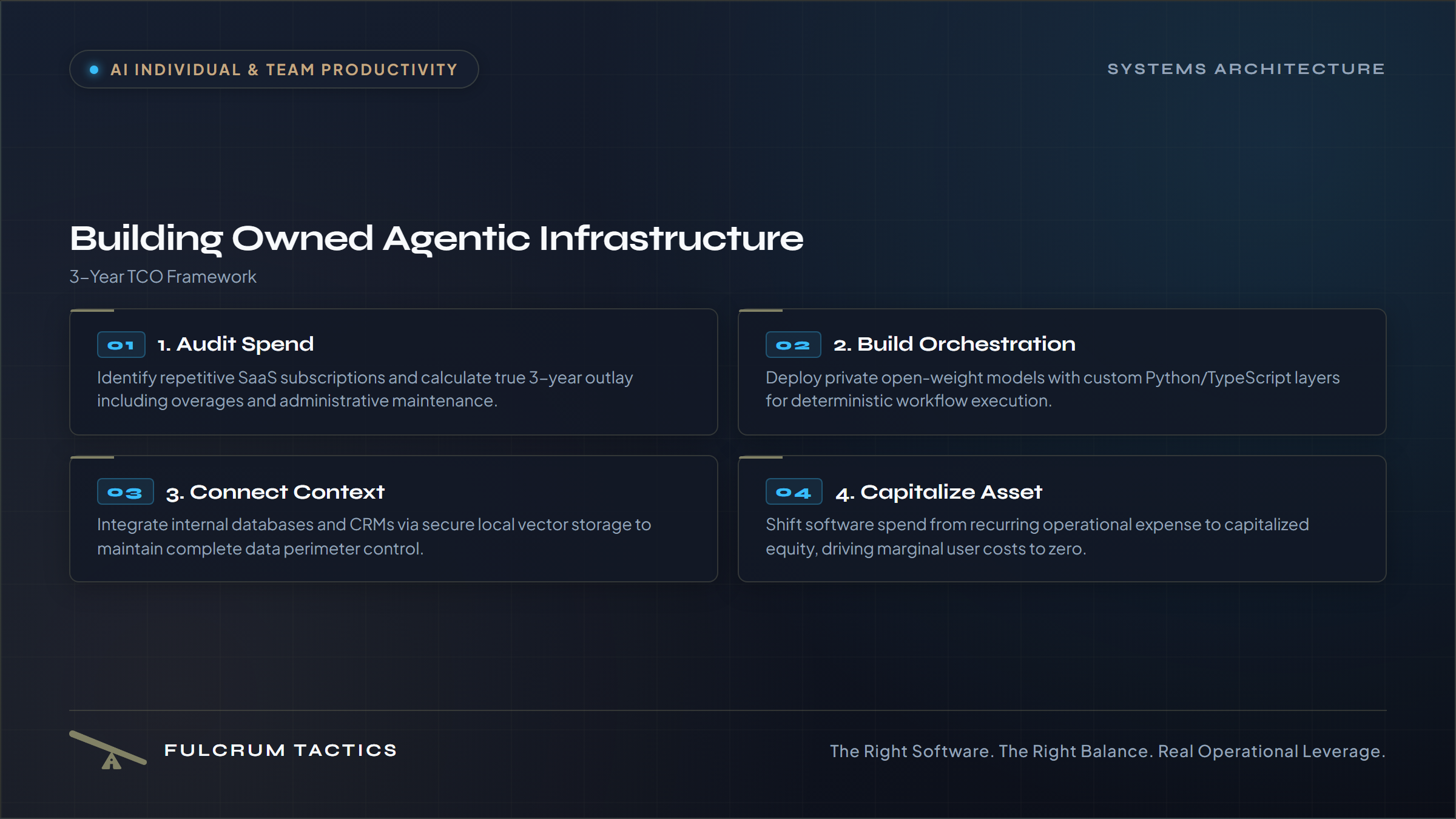
Building internal agentic infrastructure shifts this dynamic. Writing custom orchestration layers using open-source models hosted on your own infrastructure changes software from a consumable utility into a capitalized asset.
Consider the financial mechanics over a standard three-year window:
- Year 1: Initial capital outlay covers infrastructure setup, database provisioning, fine-tuning base models for specific company tasks, and setting up secure internal execution environments. Upfront costs run higher than a simple credit card SaaS signup.
- Year 2: Operating costs drop to raw compute expenses, minor model updates, and standard maintenance. Your per-user marginal cost approaches zero because adding internal team members requires no new software licenses.
- Year 3: The asset is fully integrated into your core operations. While competitors face compounding subscription increases and forced contract renewals, your operational cost remains pegged to underlying hardware and open-source model efficiencies.
This transition stabilizes cash runway. Instead of facing unpredictable monthly billing spikes tied to headcount growth, you forecast infrastructure costs with high precision.
Architecting Owned Agentic Workflows
Moving away from third-party wrappers requires a shift in how you build internal tooling. Commercial SaaS apps encourage you to adapt your workflows to their rigid user interfaces. Owned infrastructure lets you map software directly to your existing operational processes.
A practical stack begins with a secure local or private cloud environment running open-weight foundation models. Rather than sending sensitive customer data, proprietary financials, or unreleased product specs to external third-party APIs, your internal agents execute locally.
The architecture relies on three distinct layers:
- The Orchestration Layer: Custom Python or TypeScript scripts using modular frameworks that define specific agent behaviors, error handling protocols, and deterministic fallback paths.
- The Context Layer: A local vector database connected to your internal documentation, historical ticket logs, and CRM records via secure pipelines. This gives agents precise context without exposing proprietary data to public training sets.
- The Execution Layer: Controlled tool-calling interfaces that let agents interact with internal databases, generate draft invoices, or update project management boards only after passing strict validation checks.
This setup eliminates the security vulnerabilities inherent in browser-based AI extensions and third-party chat interfaces. Your data stays inside your perimeter.
Governance and Compliance by Design
Relying on external SaaS vendors creates a dangerous compliance blind spot. When employees paste client data, source code, or internal strategy documents into public AI endpoints, you lose control of your compliance posture. SOC 2 reports and vendor promises do not protect you from data leakage caused by end-user habits.
Owned infrastructure brings governance back under internal control. Because the models run on your infrastructure, you dictate the retention policies, logging levels, and access controls. If an audit requires proof that no client PII left the environment during a customer support automation run, you pull the exact execution logs from your own database.
This level of control satisfies enterprise procurement requirements much faster than waiting for a third-party SaaS vendor to answer security questionnaires or grant custom contract terms.
Making the Transition
Shifting from rented software to owned agentic infrastructure does not happen overnight. You do not need to rip out your entire tech stack by Friday.
Start by auditing your current software spend. Identify the top three recurring tools where team members use generic AI wrappers for repetitive internal tasks like parsing invoices, summarizing customer feedback, or drafting initial project specifications. Calculate the aggregate annual spend on those tools, including the administrative overhead of managing licenses.
Take a fraction of that annual budget and allocate it to a focused internal sprint. Build a single, owned agentic workflow that replaces one of those high-cost subscriptions. Measure the execution speed, accuracy, and direct cost per task.
Once your team experiences the reliability of an internal tool designed specifically for your operational patterns, the argument for accumulating more per-seat subscriptions evaporates. You stop renting productivity and start building enterprise value.