
When a sudden real estate shift forced Dodo Coffee to give up its brick-and-mortar location, the shop didn't go under. The reason was simple: the owners never confused their physical lease with their customer base. Because they maintained a direct, portable list of customer contacts and order preferences, they reopened in a new spot just a few weeks later without losing their regular crowd.
Many small and midsize businesses (SMBs) run into the exact same problem online, but with far worse outcomes. They build their entire audience on "rented land"—relying entirely on Instagram feeds, TikTok algorithms, Amazon storefronts, or Shopify plugins to reach the people who buy from them.
When those platforms change their rules, shift algorithms, or hike ad costs, profit margins evaporate overnight. To build an enduring business, you have to treat customer relationships as independent business assets you own outright, not temporary perks of a third-party app. That shift is called Decoupled Audience Architecture.
What is Decoupled Audience Architecture?
**Decoupled Audience Architecture is an operational strategy that separates your primary customer records from the third-party platforms used to market and sell to them.** By storing contact details, purchase history, and direct preferences in an independent, portable database, businesses can switch sales channels or marketing tools without losing their customer relationships.
Coupled vs. Decoupled Architecture
┌─────────────────────────┬────────────────────────────┬────────────────────────────┐
│ Attribute               │ Coupled (Rented Land)      │ Decoupled (Owned Asset)    │
├─────────────────────────┼────────────────────────────┼────────────────────────────┤
│ Customer Data Storage   │ Locked in marketplace/POS  │ Central, independent CRM   │
│ Channel Migration Time  │ Weeks or impossible        │ Under 4 hours              │
│ Communication Access    │ Algorithmic & pay-per-view │ Direct (Email, SMS, Web)   │
│ Long-Term CAC Impact    │ Recurring platform "tax"   │ Decreases as equity builds │
└─────────────────────────┴────────────────────────────┴────────────────────────────┘
---
---
Why is Platform Dependency a Financial Risk for Growing Businesses?
Relying entirely on all-in-one sales platforms creates convenience early on, but it quickly turns into an expensive platform tax. When your customer list, checkout engine, and messaging tools are locked inside one vendor, that vendor controls your unit economics.
Take beauty and lifestyle brands that rely entirely on third-party digital marketplaces for customer acquisition. When a company trades margin or heavy ad spend just for visibility inside an algorithm, it doesn't actually own the buyers it wins. The marketplace owns them. If that platform raises its seller fees or tweaks its search rankings, the brand's margins disappear.
Without an owned, direct line of communication, your Customer Acquisition Cost (CAC) becomes a permanent toll instead of a one-time investment. You end up paying the platform over and over just to get your own products in front of the same returning customers.
What are the 3 Core Components of an Owned Customer Architecture?
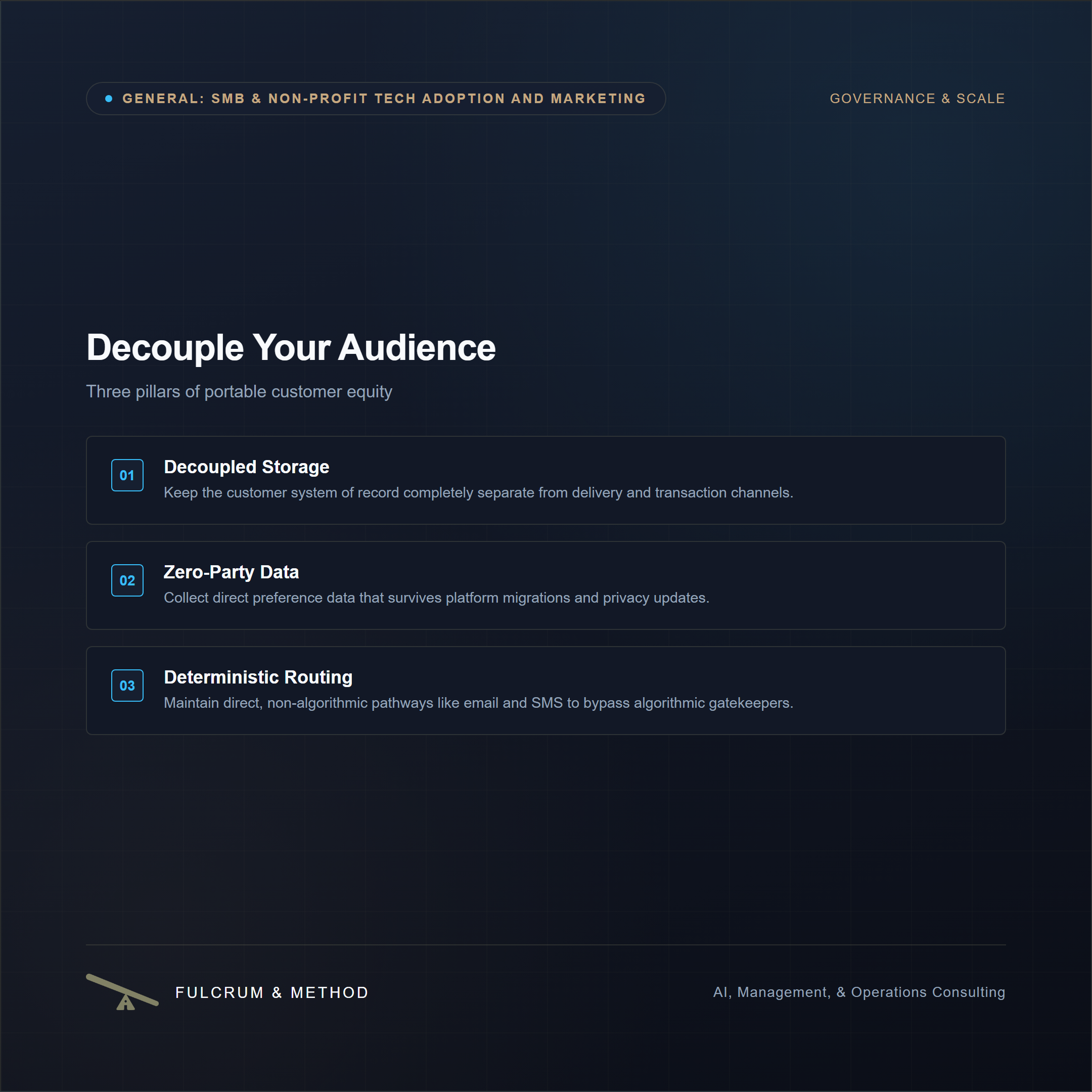
Building an independent customer base doesn't require an enterprise IT budget. It relies on three straightforward operational pillars:
- A Channel-Agnostic System of Record: Your customer relationship management (CRM) database must exist independently of your storefront or ad accounts. If you switch e-commerce platforms or swap out your point-of-sale hardware tomorrow, your customer records should remain untouched.
- Zero-Party Data Collection: Rather than relying on third-party ad pixels—which privacy updates increasingly block—ask customers directly about their needs. Zero-party data is information buyers intentionally share with you, like sizing preferences, purchase frequency, or specific project requirements.
- Deterministic Communication Channels: Maintain at least two direct channels to every customer that no algorithm can throttle—specifically verified email addresses and consented SMS numbers.
How Do You Migrate to a Decoupled Model Step-by-Step?
Transitioning to an owned data model is an operational routine, not a disruptive multi-month software overhaul.
Migration Flow:
[Audit Locked Records] ──> [Sync to Independent CRM] ──> [Capture Zero-Party Inputs] ──> [Run 4-Hr Migration Drill]- Audit your data touchpoints: Check where your customer records currently live. If order histories exist only inside a proprietary point-of-sale terminal or marketplace backend, your business is exposed. Set up automated daily exports or simple API connectors to back that data up to an independent, central CRM.
- Collect practical zero-party details during checkout: Redesign onboarding and purchase flows to gather 1–2 practical details that help you serve the customer better. A coffee roaster might ask how someone brews at home (French press, espresso, drip); a B2B supplier might ask for project scale. Store these preferences directly in your central database.
- Run a quarterly migration drill: Test your team's ability to export your contact list, upload it to a separate email or messaging tool, and send a live message within four hours without losing customer tags or opt-in histories. If your data is too tangled to pass that test, you are still tied to the platform.
How Does Decoupled Data Strengthen Your Business Valuation?
Direct customer relationships are one of the most valuable assets on an SMB's balance sheet, provided they are truly portable. When a business is evaluated for financing, a partnership, or an acquisition, a clean database of verified contacts with clear purchase preferences is treated as proprietary intellectual property. A large social media following with no direct contact details is viewed merely as rented marketing reach.
Decoupling your customer data protects your operating margins against sudden platform changes, lowers your long-term acquisition costs, and steadily builds lasting customer equity. Use third-party platforms as temporary discovery funnels, but keep the keys to your customer relationships in your own hands.
🔗 Ingested Source Material & References
- [Inc. Magazine] Will Buxton on the Historic Nature (and Personal Relevance) of the IndyCar Freedom 250 GP
I spoke with FOX Sports IndyCar broadcaster Will Buxton about calling this weekend’s Freedom 250 GP of Washington, D.C. and about not trying to “force” viral moments.
...
- [Inc. Magazine] Dodo Coffee Lost Its Storefront. What Happened Next Revealed Why Customers Really Stay
Lose the storefront. Keep the customers.
...
- [Inc. Magazine] Technology Is No Longer the Market’s Priciest Sector. The New Leader Is an Old-Economy Group
Industrials represent a potential catch-up trade against tech and the S&P 500.
...
- [Inc. Magazine] A Target-Backed Beauty Founder Admits Her Brand ‘Isn’t Working.’ Rather Than Shut It Down, She’s Offering Equity to Revive It
Melissa Butler is offering equity in Thread Beauty to whomever can bring the audience she can’t.
...
- [Inc. Magazine] SpaceX Says $1.8 Million Left a Contractor’s Account Before Bankruptcy. Now It’s Fighting to Keep the Case Open
Alpha Building transferred nearly $1.8 million after settling a dispute with SpaceX. The rocket company says the bankruptcy estate may have claims to recover the money.
...