
Bottom Line Up Front (BLUF)
Enterprise software vendors lock basic automated text generation and document processing behind $50 to $75 per-seat monthly surcharges. For a mid-market team of 200 employees, these add-ons inject $120,000 to $180,000 in recurring annual overhead. Most proprietary CRM AI add-ons simply wrap foundation model APIs inside standard web UI components. Operations teams cut workflow execution costs by 80% to 90% by replacing per-seat AI tiers with an owned orchestration layer. Connecting lightweight open integration standards—such as Model Context Protocol (MCP) servers—directly to core databases and external APIs allows organizations to run automated workflows paid strictly on raw token consumption.
The Flawed Math of Per-Seat AI Add-Ons
Traditional SaaS licensing charges for user access. AI execution costs depend on compute cycles, context window size, and token throughput. When enterprise platforms bundle capabilities into high-tier seats, they decouple pricing from operational consumption.
Consider an organization processing 15,000 customer record updates per month across 150 sales and support seats:
- Vendor Per-Seat Model: 150 seats × $60/month = $9,000/month ($108,000/year).
- Direct API Model: 15,000 workflow executions × ~10,000 tokens per execution = 150,000,000 total tokens. At standard foundation model rates ($3.00 per million tokens input/output blend), raw compute equals $450/month ($5,400/year).
The vendor model forces companies to buy compute access for staff who trigger AI operations infrequently. The underlying intelligence in both deployment models relies on identical foundation models. Paying a 20x markup to execute prompts inside a proprietary CRM tab diverts capital away from internal infrastructure.
Decoupled Architecture: Building the Owned Agentic Layer
Uncoupling AI execution from the CRM interface requires separating three responsibilities: event ingestion, context retrieval, and action dispatch. Instead of letting the CRM control the context window and API calls, the CRM functions solely as a relational datastore and user interface.
+-------------------+      Webhooks / CDC      +-----------------------+
| Core CRM Database | -----------------------> | Orchestration Engine  |
+-------------------+                          | (Python / TypeScript) |
          ^                                    +-----------------------+
          |                                                |
          | Direct Writeback                               | API Tokens
          | (REST / Postgres)                              v
+-------------------+                          +-----------------------+
| Target System     | <----------------------- | Foundation Model API  |
| (DocuSign / MCP)  |    Open Protocol Calls   | (Claude / OpenAI)     |
+-------------------+                          +-----------------------+
The decoupled architecture relies on four operational components:
- Event Capture: Webhooks or Change Data Capture (CDC) streams (such as PostgreSQL logical replication) detect record state changes, such as a status field update on a contract.
- Open Protocol Interfaces: Open servers—like DocuSign's Open MCP Server implementation or lightweight internal node services—expose tool definitions, data schemas, and execution boundaries directly to an internal orchestration engine.
- Worker Pool & Pipeline Orchestration: An execution engine (such as Temporal, Prefect, or serverless workers) manages application state, handles token payload assembly, and executes retries.
- Direct Database Writeback: Workers run LLM responses through strict runtime schema validation before writing structured outputs back to the database or CRM REST endpoints using standard service accounts.
Schema Validation and Protocol Plumbing
To prevent hallucinated fields from writing invalid data to production tables, raw LLM outputs must pass through strict schema validation before database updates occur.
The following TypeScript implementation demonstrates an open orchestration worker. The process extracts context, queries an external model, enforces runtime schema validation, and dispatches instructions through an open protocol server:
import { z } from "zod";

// Define deterministic runtime schema for CRM record processing
const ContractUpdateSchema = z.object({
  accountId: z.string().uuid(),
  opportunityId: z.string().min(1),
  renewalTermsYears: z.number().int().min(1).max(5),
  annualValue: z.number().positive(),
  legalClauseOverrides: z.array(z.string()),
});

type ContractUpdatePayload = z.infer<typeof ContractUpdateSchema>;

export async function processWorkflowEvent(rawEvent: { record_id: string }): Promise<void> {
  // 1. Fetch raw database context directly
  const recordContext = await fetchDatabaseContext(rawEvent.record_id);

  // 2. Query foundation model via direct pay-per-token API
  const llmResponse = await queryFoundationModel({
    prompt: `Extract agreement terms from context: ${JSON.stringify(recordContext)}`,
    responseFormat: "json",
  });

  // 3. Enforce strict deterministic schema validation
  const parseResult = ContractUpdateSchema.safeParse(JSON.parse(llmResponse.rawText));

  if (!parseResult.success) {
    await logValidationFailure(rawEvent.record_id, parseResult.error);
    throw new Error(`Data validation failed: ${parseResult.error.message}`);
  }

  // 4. Dispatch payload to target execution system via Open MCP tool call
  await executeMcpToolCall({
    serverUrl: "https://mcp.internal.net/v1/docusign",
    tool: "create_envelope",
    payload: parseResult.data,
  });
}
This structural separation insulates business rules from frontend changes. If the vendor alters their UI layout or changes seat pricing tiers, the underlying execution logic and database pipelines remain operational.
Governance, Auditing, and Rate Control
Vendor platforms manage execution logic behind black-box interfaces, hiding prompt structures, raw token consumption, and rate limits. Building an owned orchestration layer restores visibility and operational control:
- PII Sanitization at the Edge: Strip Personally Identifiable Information (PII) using local regular expressions or named-entity recognition (NER) models before payloads leave your local network boundary.
- Deterministic Execution Traces: Log prompt input hashes, system context snapshots, schema validation errors, and token expenditures into an append-only PostgreSQL audit table.
- Rate Control and Backoff: Queue worker tasks using Redis (e.g., BullMQ or Celery) to control concurrency, handle rate limits gracefully, and avoid database connection exhaustion.
- Zero Per-Seat Access Control: Administer system permissions using standard network Role-Based Access Control (RBAC) and service accounts instead of buying user licenses for inactive staff.
Tactical Migration Checklist
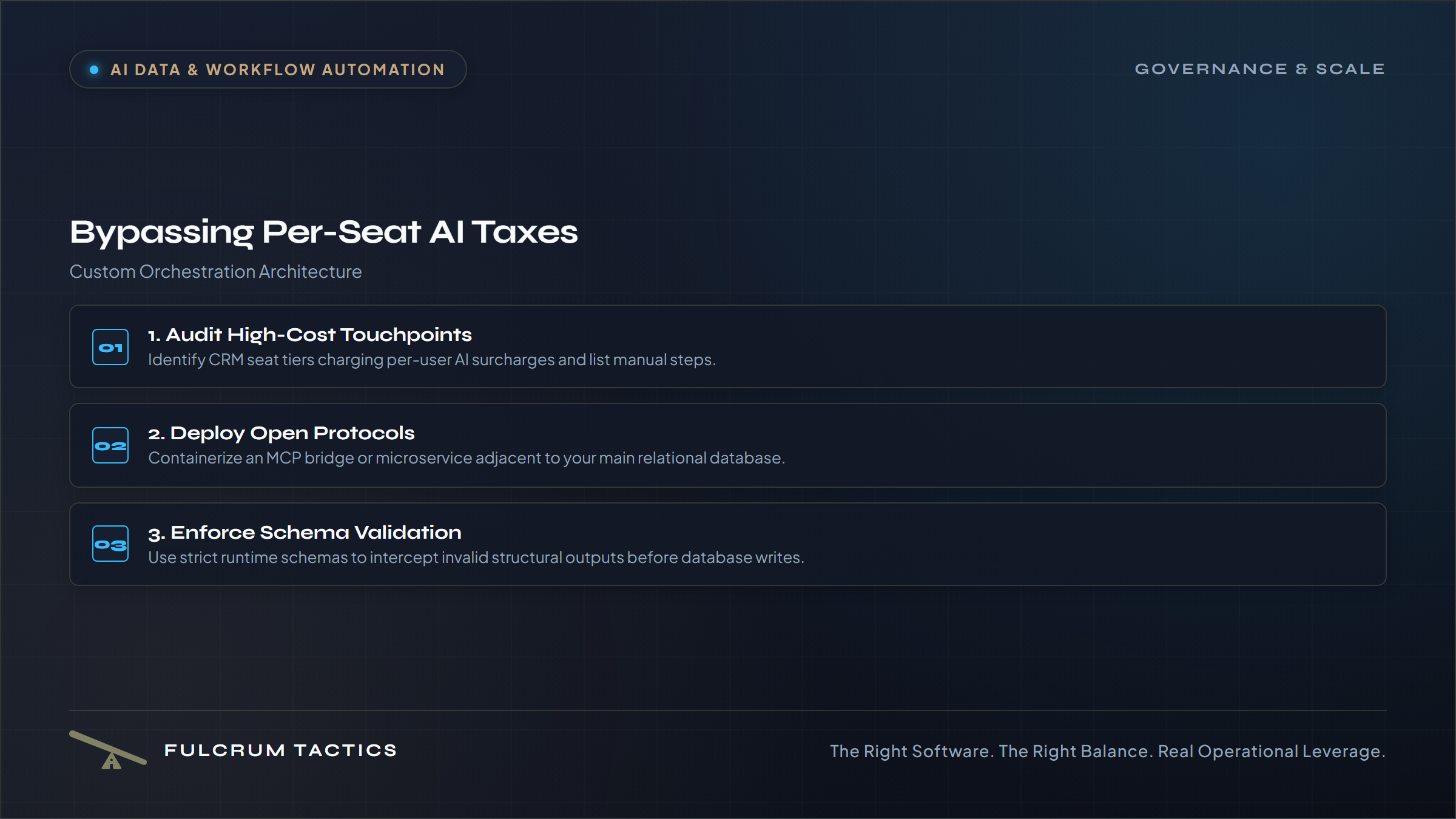
- Audit High-Cost Touchpoints: Identify CRM seat tiers charging per-user AI surcharges. List the specific manual actions, field updates, or summary steps performed by those users.
- Deploy an Open Protocol Layer: Containerize an MCP bridge or lightweight microservice adjacent to your main relational database. Connect open protocols (such as open contract management endpoints or internal SQL connectors).
- Reroute Event Triggers: Reconfigure CRM UI workflow actions to send lightweight HTTP POST webhooks to your internal worker pool.
- Implement Runtime Schemas: Define explicit validation schemas (using Zod or Pydantic) to intercept bad structural outputs before database writes complete.
- Downgrade SaaS Tiers: Revoke high-tier AI licenses in the vendor console, reverting user seats to basic access tiers while preserving full operational automation.
🔗 Ingested Source Material & References
- [MIT Technology Review - AI] Architecting memory and storage in the AI era
> The era of AI inference has arrived. Imagine a healthcare system analyzing millions of data points in real time to accelerate life-saving medical research, or an intelligent assistant instantly resolving thousands of com...
- [Small Business Trends] Salesforce Unveils Claudeforce: Transforming Customer Experiences
> Discover how Salesforce's latest innovation, Claudeforce, is revolutionizing customer experiences by leveraging cutting-edge technology and data-driven insights. Explore the transformative features and benefits that will...
- [Small Business Trends] DocuSign Unveils Open MCP Server, Enhancing AI Integration for Enterprises
> Discover how DocuSign's new Open MCP Server is revolutionizing AI integration for enterprises, streamlining workflows, and enhancing document management capabilities. Explore the features and benefits that empower busine...
- [Practical Ecommerce] Do We Still Need Google Disavow?
> Yes, Google's Disavow tool remains useful for manual, link-related penalties.
The post Do We Still Need Google Disavow? appeared first on Practical Ecommerce....
- [Practical Ecommerce] The Race to Own AI Shopping
> Will shoppers use AI mostly on external platforms, or on-site directly with merchants?
The post The Race to Own AI Shopping appeared first on Practical Ecommerce....