
Most business finance and operations systems share a major vulnerability: assuming human review can catch mistakes before real damage occurs. When workflows took hours or days to process, reviewing logs at the end of the week was enough to spot an issue and reverse it.
Autonomous AI agents change that dynamic completely. Today, a procurement agent can read an incoming invoice, match it to a contract, trigger an API payment, and update your accounting ledger in a fraction of a second without anyone clicking an approval button.
That speed brings real operational risk. If an agent misreads a decimal place, loops on a task, or gets tricked by a manipulated PDF invoice, the money is gone long before an alert reaches your inbox. Relying on end-of-day batch reports to supervise autonomous software is like trying to catch a baseball after it has already cleared the fence.
What is Inline Governance for AI Agents?
Inline governance is an operational architecture that places hardcoded, automated validation rules directly inside an AI agent's execution path. Rather than checking logs after a task finishes, inline guardrails evaluate every transaction payload against predefined business policies before any funds move or database records change.
Post-Facto Auditing vs. Inline Governance
┌─────────────────────────┬────────────────────────────┬────────────────────────────┐
│ Dimension               │ Traditional Auditing       │ Inline Governance          │
├─────────────────────────┼────────────────────────────┼────────────────────────────┤
│ Timing                  │ Post-execution (End of day)│ Pre-execution (Real-time)  │
│ Verification Method     │ Manual sampling & log review│ Deterministic rule engines│
│ Latency Impact          │ None during runtime        │ <10 milliseconds           │
│ Error Containment       │ Reactive loss recovery     │ Immediate automated block  │
└─────────────────────────┴────────────────────────────┴────────────────────────────┘
Why is Post-Facto Auditing Dangerous for Autonomous Workflows?
Traditional auditing relies on hindsight. Finance teams review transaction reports weekly or monthly under the assumption that mistakes happen slowly and are easily fixed.
With autonomous agents, errors compound instantly. A single prompt injection or faulty API loop can trigger hundreds of unauthorized payouts in minutes. According to the Association of Certified Fraud Examiners (ACFE), organizations lose an estimated 5% of their annual revenue to fraud and billing errors, with delayed detection causing the largest losses. When software acts in milliseconds, the detection window must happen in milliseconds too.
Reviewing audit logs after the fact is no longer a risk strategy. Operations teams must shift from spotting mistakes after they happen to preventing them at runtime.
What are the 3 Layers of an Inline Governance Architecture?
You do not need to build larger, more expensive AI models to supervise your agents. Instead, place standard, lightweight software guardrails between the agent and your core systems:
Transaction Flow:
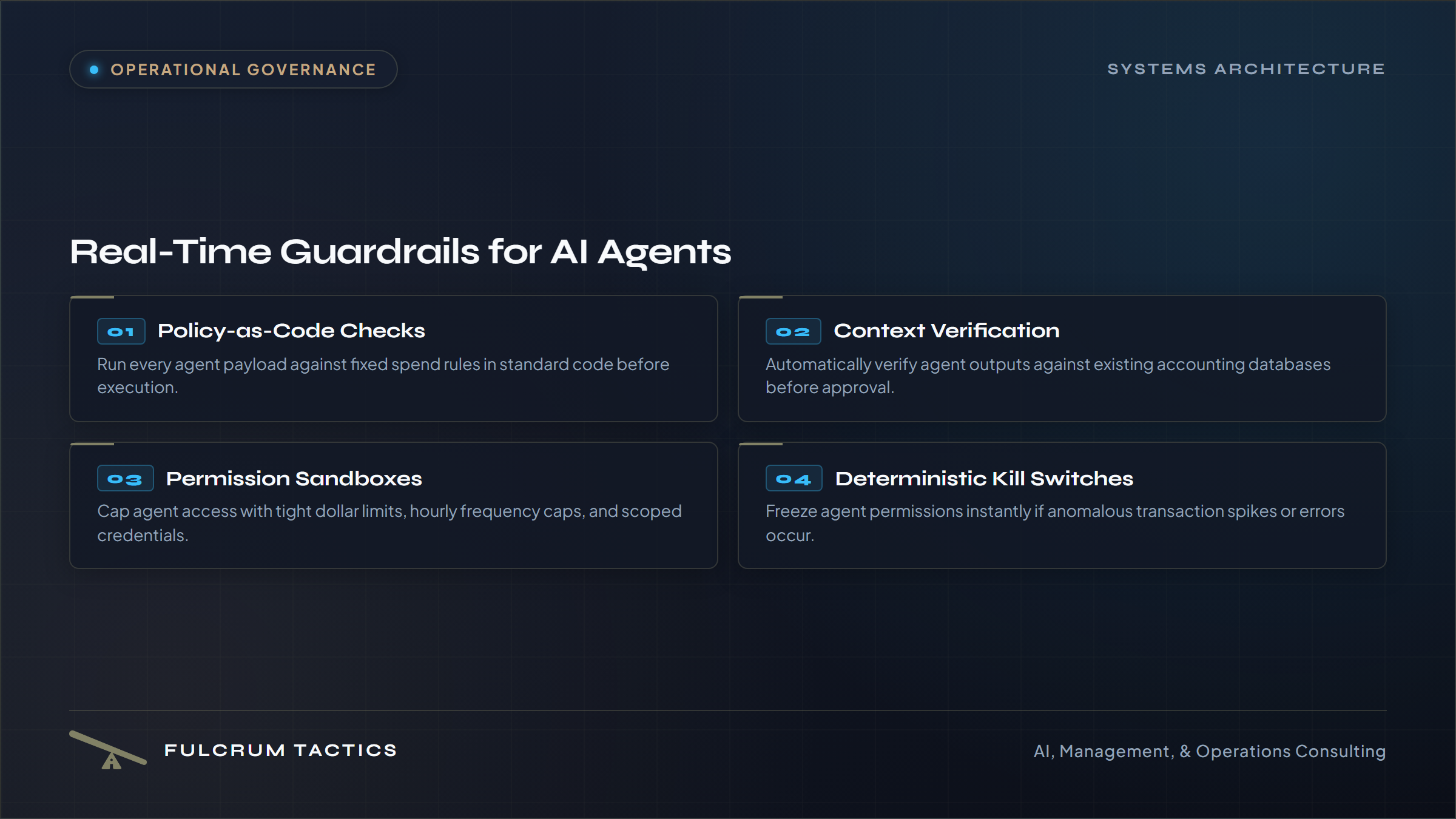
[AI Agent Generates Payload] ──> [1. Policy-as-Code Engine] ──> [2. Contextual Check] ──> [3. Sandboxed API] ──> [ERP / Bank]- The Policy-as-Code Engine: Before an agent sends an instruction to a bank gateway or accounting tool, the payload must pass through rigid, immutable code rules. If an agent tries to approve an invoice that exceeds a contract cap, standard code rejects it automatically.
- Contextual Verification: This layer verifies the agent's work against trusted, existing records. Does this match known business data? If an agent tries to pay a vendor whose routing number changed without an approved change order, the workflow pauses immediately for human review.
- Behavioral Sandboxes: Give agents tightly scoped permissions instead of wide API keys. Use micro-credentials that restrict how many transactions an agent can run per hour, total dollar ceilings, and approved endpoint destinations.
Does Real-Time AI Governance Slow Down System Performance?
No. A common concern is that adding security checks will create bottlenecks and defeat the point of automated speed.
That issue only happens if you use another slow AI model to police the first one. Instead, effective inline governance relies on standard, pre-compiled code. A simple Python script or database lookup can validate an invoice amount against your approved vendor list in under 10 milliseconds.
By separating the "thinking" (handled by the agent) from the "policing" (handled by straightforward software rules), workflows stay fast while eliminating unmonitored risk.
How Should Operations Leaders Implement AI Guardrails Today?
Transitioning to real-time governance starts with a simple operational inventory:
- Map agent authority: Document every workflow where an AI tool has write access to your databases, billing tools, or payment APIs.
- Establish deterministic ceilings: Set hard dollar thresholds and transaction frequency limits in code, bypassing the LLM entirely.
- Build an automatic kill switch: Implement alerts that pause agent access the moment an unexpected pattern occurs.
Inline guardrails are not about slowing your team down. They are the exact operational foundation that lets you automate critical workflows with total confidence.