
Bottom Line Up Front (BLUF)
Multi-billion dollar philanthropic pledges are flooding into artificial intelligence, yet most of this capital funds temporary subscriptions to venture-backed commercial software. This creates a dangerous dependency: when grant cycles end, non-profits face recurring software fees that erode program efficiency ratios and compromise beneficiary data privacy. Non-profit executives and board trustees should consider redirecting capacity-building grants away from per-seat SaaS licensing and toward organization-owned, open-source AI infrastructure. By building data workflows and self-hosted automation, mission-driven teams protect donor trust, control operating overhead, and directly expand frontline capacity without vendor lock-in.
The Philanthropic Misalignment in Tech Adoption
When major grantmakers commit hundreds of millions or billions of dollars to expand access to artificial intelligence, the funds frequently flow straight to commercial software providers. Non-profits receive short-term grant dollars to pilot closed-source, vendor-owned platforms. While this grants immediate access to new tools, it introduces a structural financial trap for organizations.
A commercial platform operates on recurring fees, per-seat licensing, and usage-based pricing models. When a grant period expires, the non-profit must absorb these ongoing operational costs into its general budget. Money targeted for direct community programs is diverted to sustain commercial software subscriptions.
Furthermore, top-down funding decisions rarely consult frontline managers about operational realities. Grantees need a strong voice in determining how technology capital is deployed, ensuring that funding builds permanent organizational capacity rather than temporary software dependencies. Long-term donor relationships must be grounded in sustainable infrastructure, not recurring license overhead.
The Fiduciary Risk of Commercial AI Platforms
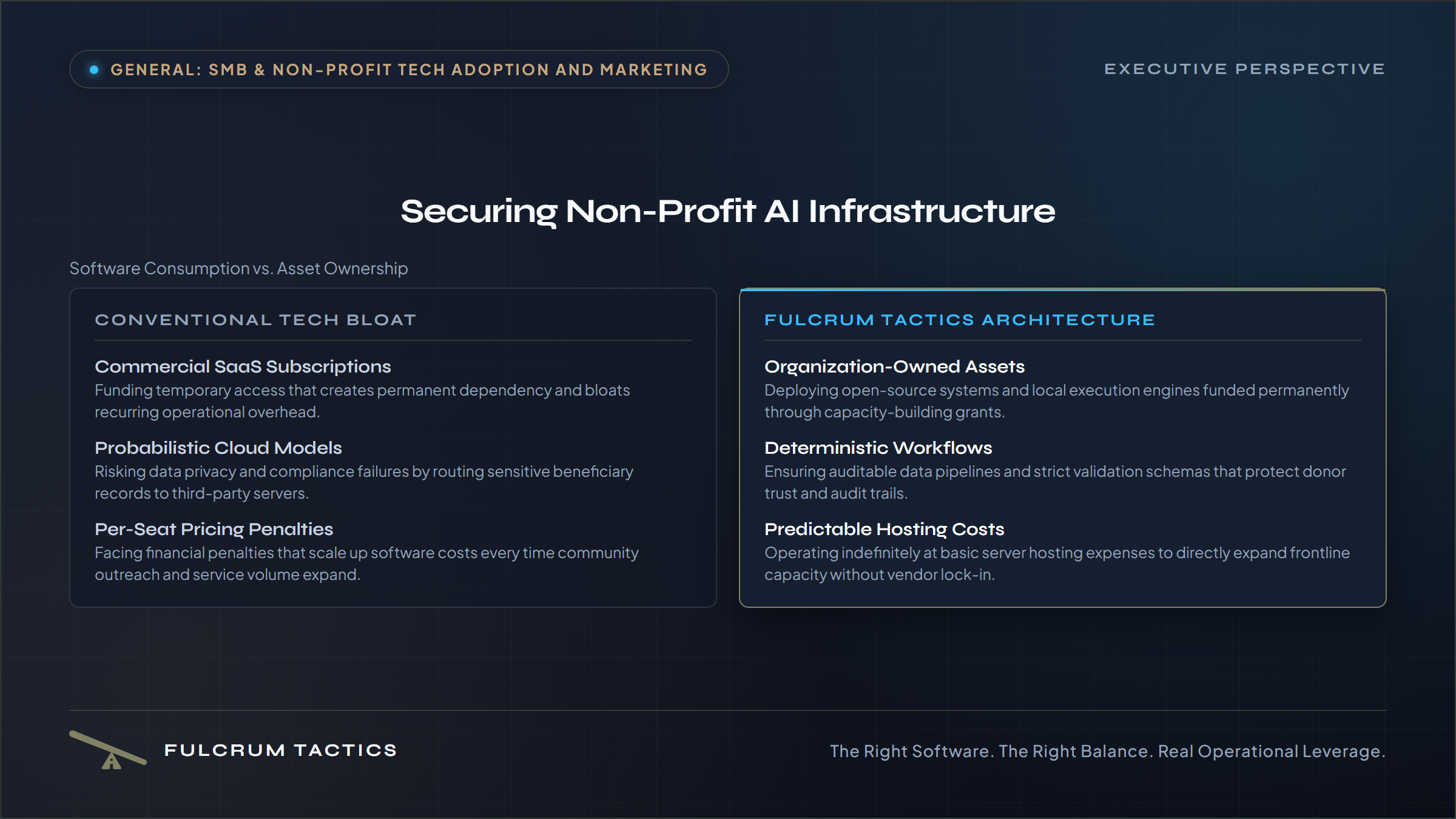
Relying on commercial AI vendors introduces governance and fiduciary challenges for non-profit boards. When frontline staff upload sensitive beneficiary intake forms, housing applications, or donor history records into public commercial clouds, organizations risk violating strict privacy standards and donor trust. Commercial platforms routinely reserve the right to retain user data to train proprietary systems, turning confidential community information into vendor assets.
Operationally, commercial AI tools rely on probabilistic guessing. In intake workflows or financial reporting, an AI model that misinterprets data creates immediate compliance failures. When a grant reporting deadline arrives or auditors inspect Form 990 Part IX allocations, probabilistic output cannot replace deterministic, auditable workflows. Non-profits cannot afford software that guesses on critical compliance records.
Commercial pricing structures actively penalize mission growth. If expanding community outreach doubles intake volume, API usage fees double alongside it. This creates a direct financial penalty for serving more people, forcing leadership to choose between operational growth and overhead constraints.
Building Owned Software Assets with Capacity Grants
Mission-driven leaders must shift technology strategy from software consumption to infrastructure ownership. Capacity-building grants should fund perpetual community assets: software code, local execution engines, and open-source models that reside entirely within the organization's control.
Instead of paying monthly seat taxes for commercial AI platforms, organizations can deploy open-weight foundation models on controlled server instances or local hardware. Coupled with deterministic validation pipelines, this approach creates an auditable system where data processing rules are explicit, fully verifiable, and free from recurring per-seat fees.
Consider a high-volume community intake process:
- Data Ingestion: Standardized intake documents pass through local document processing scripts.
- Deterministic Validation: Rules-based schemas verify applicant eligibility criteria, tax identification numbers, and contact fields against strict logical constraints.
- Local Machine Processing: Open-weight language models clean unstructured narrative notes into strict JSON formats without routing donor or beneficiary data through commercial external APIs.
- Audit Logging: Every record transformation produces an immutable log, ready for immediate grant compliance verification and audit trails.
Once built, this workflow operates indefinitely at basic server hosting cost. Doubling community service volume increases utility costs by pennies rather than thousands of dollars in commercial software fees.
A Governance Framework for Board Trustees and Executives
Redirecting technology capital requires clear action from Executive Directors and Board Trustees during grant negotiations and strategic planning cycles.
- Enforce Infrastructure Ownership in Grant Applications: Structure capacity-building requests to fund open-source systems, custom automated pipelines, and localized hosting. Reject grant terms that require recurring subscriptions to vendor-locked platforms.
- Mandate Data Sovereignty and Privacy: Establish clear data governance policies that strictly prohibit pasting beneficiary record details or confidential donor communications into commercial AI services that train on user inputs.
- Audit Overhead Efficiency Metrics: Track software spending within Form 990 Part IX reporting. Transition technology expenditures from recurring administrative overhead into capitalized, grant-funded assets.
- Measure Relief of Frontline Burnout: Evaluate technology initiatives by the administrative hours returned to case managers and program directors. Software should eliminate repetitive manual typing and intake entry, freeing staff to engage directly with the community.
By establishing technical independence, non-profit leadership fulfills its fiduciary duty to donors and grantees alike. Owning operational infrastructure guarantees that philanthropic capital permanently expands service capacity, protecting both donor trust and institutional longevity.