Bottom Line Up Front (BLUF)
Renting commoditized intelligence by the seat is an operating expense trap. Paying monthly premiums per employee for general-purpose AI chat tools ties software costs directly to headcount rather than actual productivity or business output. This creates a compounding financial liability that degrades operating margins as your team grows. By transitioning to sovereign AI stacks—deploying open-weights models on dedicated virtual hardware or private, flat-rate APIs—owners can turn recurring software taxes into predictable, owned operational CapEx. This shift stabilizes the three-year total cost of ownership (TCO), protects operational data, and shields workflows from sudden, arbitrary vendor pricing shifts.
The Per-Seat Tax on Growth
Modern software vendors are aggressively redesigning their pricing models. Standard business applications are introducing autonomous agent tiers and AI add-ons that charge a heavy premium per user. When a growing business expands its team, payroll naturally increases. But under the current software-as-a-service (SaaS) regime, software licensing fees also jump proportionally.
Adding basic utility AI to every seat multiplies this premium. If every team member requires an additional monthly subscription fee to use core cognitive tools, the business is penalized for hiring. This pricing structure assumes that a model's value to your business scales linearly with the number of human eyeballs looking at the screen. In reality, it does not.
Most team members use these tools sporadically—to draft an email, summarize a meeting, or parse an intake form. Yet, the business pays the same flat monthly premium for a light user as it does for a heavy user. Furthermore, these commercial tools are built on shared public models. You pay a premium markup for a generic wrapper around an LLM that is identical to what your competitors use. This is a recurring tax on basic business operations, not a strategic differentiator.
The Sovereign Alternative: AI as Fixed-Asset CapEx
The alternative is AI sovereignty: hosting open-weights models (such as Llama 3 or Mistral) on dedicated cloud compute or private, single-tenant servers. Under this model, your costs are determined by compute resource consumption (tokens processed) rather than headcount.
Consider the operational mechanics. If fifty employees query an internal knowledge base, their combined actual active processing time might only equal a few hours of GPU compute per day. Instead of paying fifty individual SaaS licenses, a business can pay a flat monthly rate for a dedicated virtual GPU node.
The economic curves of these two approaches diverge sharply:
```
[Per-Seat SaaS Model]    Cost scales linearly with Headcount:
                         10 Users  --> $$$
                         100 Users --> $$$$$$$$$$ (Runaway OpEx)
[Sovereign AI Stack] Cost scales with compute usage, capped by flat-rate GPU node: 10 Users --> $ 100 Users --> $ (Flat CapEx/OpEx, high margin efficiency) ```
By owning the infrastructure stack, you decouple software costs from headcount. If you double your team, your infrastructure costs remain flat until you hit the physical limits of your virtual machine. This shifts the financial profile of AI tools from a variable, unpredictable OpEx liability into a stable, manageable capital or operating asset.
Protecting Team Sanity and Data Capital
Beyond the balance sheet, the per-seat rental model introduces qualitative operational risks. Commercial software vendors frequently update user interfaces, alter underlying models without warning, and deprecate features to force migration to higher-tier products. For a lean team, this constant instability is a operational drain. A workflow that functioned perfectly on Friday can break on Monday because a vendor updated their proprietary API weights over the weekend.
A sovereign AI stack provides complete control over the application lifecycle. If your operations depend on a specific model parameters to extract invoice data or draft client reports, that model remains static until you choose to upgrade it. Your internal workflows remain deterministic, predictable, and protected from external development cycles.
Additionally, data custody is a critical factor in long-term business valuation. Sending proprietary customer interactions, operational logs, and financial ledgers through commercial APIs exposes your business to data policy changes and training-data ingestion. A sovereign stack keeps all data processing within a private virtual private cloud (VPC). The model parameters, training runs, and vector databases become permanent, proprietary company assets rather than data fuel for a third-party vendor's product development.
The 3-Year TCO Blueprint
To evaluate the financial impact, compare the three-year total cost of ownership (TCO) of a rented SaaS model against an owned, sovereign stack for a team of 50 users.
Option A: The Per-Seat SaaS Model
- AI Chat Assistant Add-on: $30 per user / month
- CRM AI Agent Add-on: $50 per user / month
- Total monthly cost per user: $80
- Monthly run rate (50 users): $4,000
- Year 1 Cost: $48,000
- Year 2 & 3 Cost (assuming 15% headcount growth): $111,600
- 3-Year TCO: $159,600 (Pure OpEx with zero asset equity)
Option B: The Sovereign AI Stack
- Initial Development & Pipeline Setup (One-time CapEx): $25,000 (Custom database connections, local model integration, and interface setup)
- Dedicated Cloud GPU Hosting (Flat-rate OpEx): $350 / month (NVIDIA L4 or equivalent virtual GPU instance, capable of serving 100+ active users)
- System Maintenance & Updates: $200 / month
- Year 1 Cost: $31,600 (Includes initial setup)
- Year 2 & 3 Cost (with zero headcount penalties): $13,200
- 3-Year TCO: $44,800
3-YEAR TCO COMPARISON
=============================================
Option A (Per-Seat SaaS):   ||||||||||||||| $159,600
Option B (Sovereign Stack): |||| $44,800
=============================================
Preserved EBITDA:           $114,800
The financial return is clear, but the strategic return is even greater. The custom prompt pipelines, database connectors, and model configurations developed in Option B belong to your company. They exist on your balance sheet as proprietary software assets that enhance the enterprise value of the business.
Executing the Transition
Transitioning to an owned AI stack does not require building models from scratch. The open-source ecosystem provides mature, pre-trained models that match or exceed the performance of commercial APIs for specific business tasks.
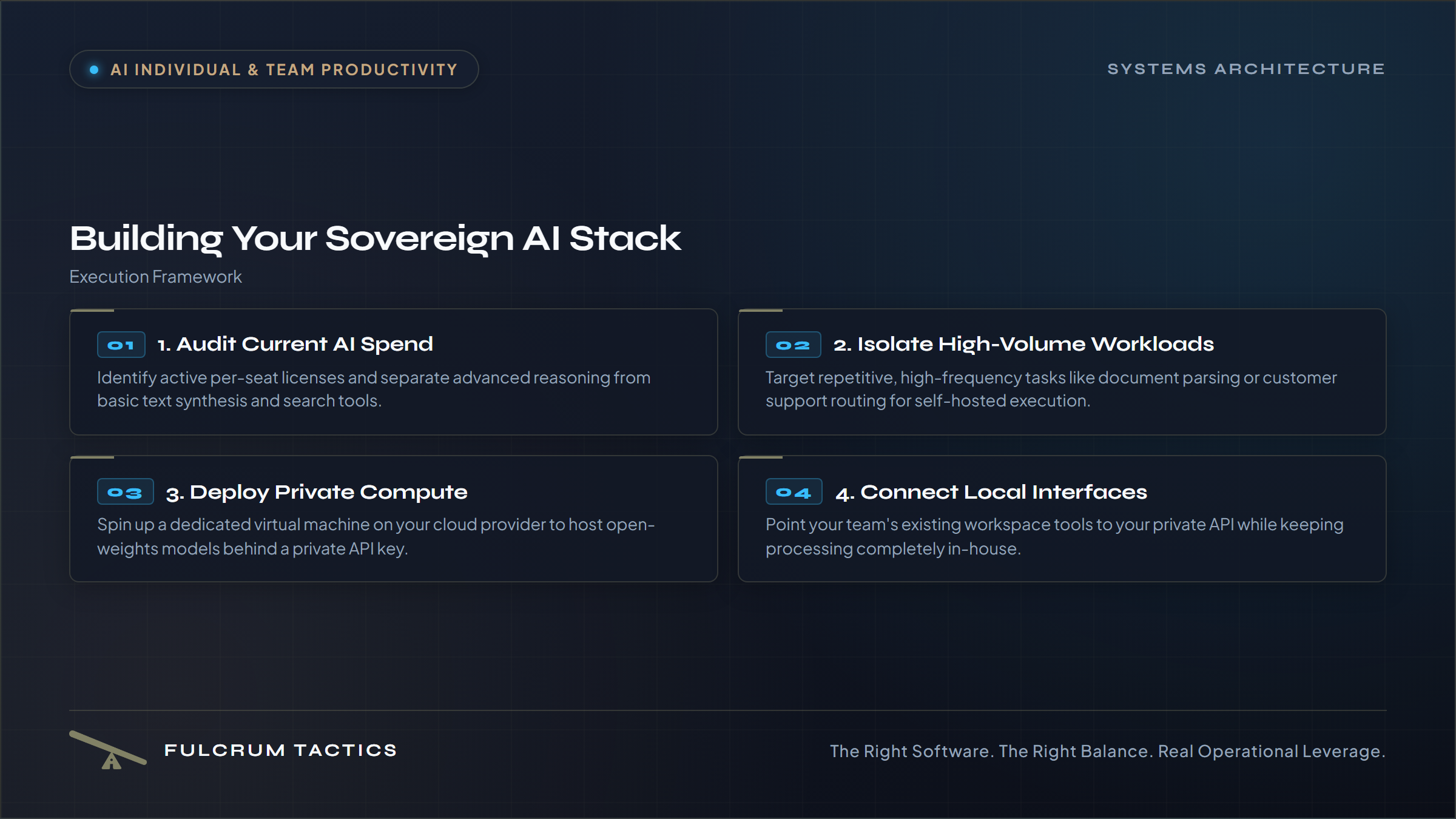
- Audit Your Current AI Spend: Identify where per-seat AI licenses are currently active. Is the team using them for advanced reasoning, or are they primarily doing basic text synthesis, search, and summarization?
- Isolate High-Volume Workloads: Target repetitive, high-frequency tasks—such as document parsing, customer support routing, or database querying—for transition to a self-hosted model first.
- Deploy Private Compute: Set up a virtual machine within your existing cloud infrastructure provider. Use open-weights runtimes to host your chosen model behind a private API key.
- Connect Local Interfaces: Point your team's existing workspace tools to your private API. The user experience remains identical, but the processing occurs on your owned virtual hardware.
By taking control of the infrastructure, you eliminate the recurring SaaS tax on team growth. You turn a variable operational drain into a highly efficient, predictable asset that scales with your business, not your headcount.