Bottom Line Up Front (BLUF)
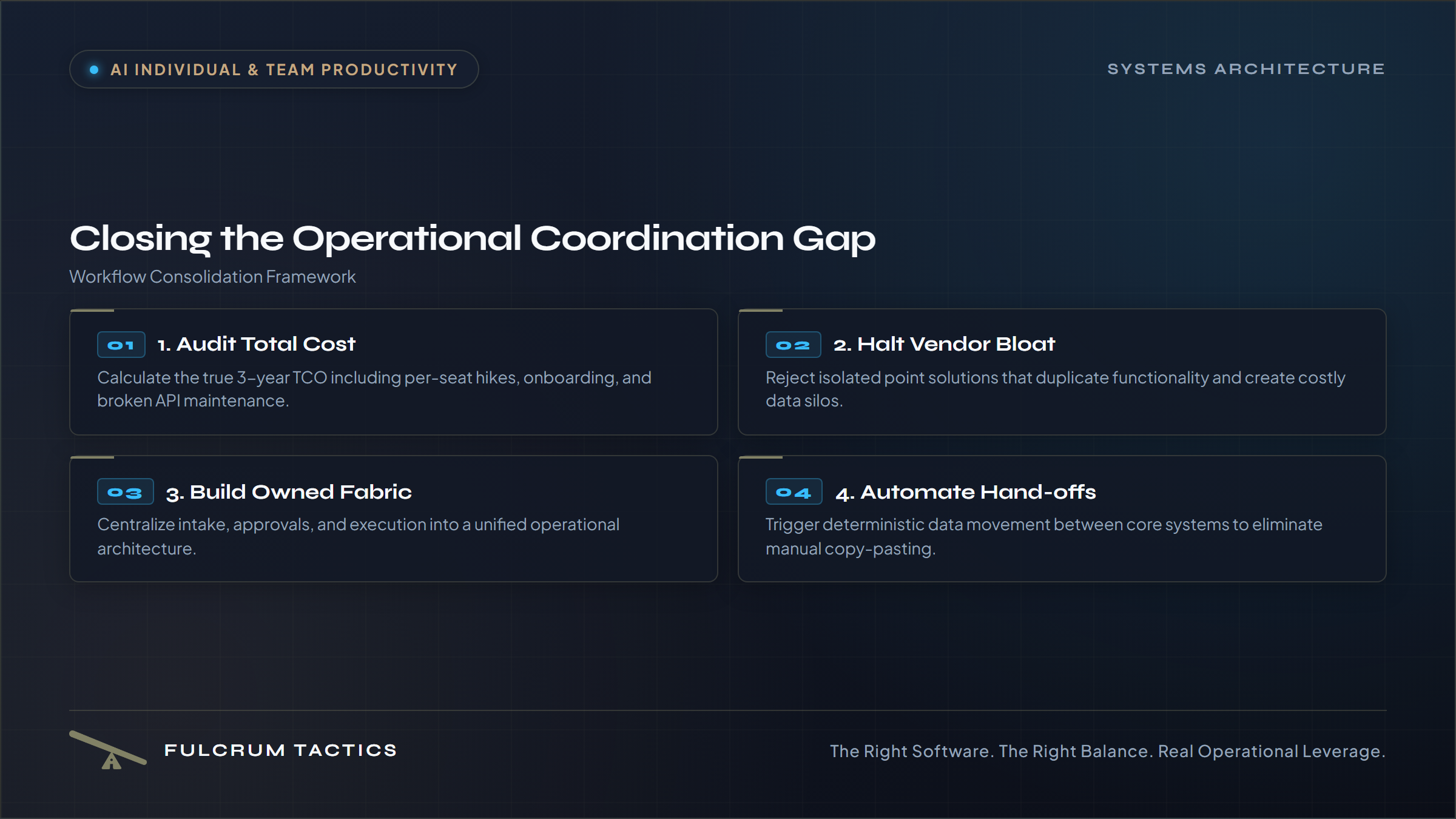
Every time your team adopts a new point solution to fix communication friction, you add another recurring software tax and fracture your operational data. Buying isolated tools creates a coordination gap that forces staff to jump between five different tabs just to complete a single task. Protecting your operating margins requires rejecting vendor-bloat, eliminating redundant subscriptions, and consolidating workflows into an owned, unified operational fabric.
The Anatomy of the Coordination Gap
When teams miss deadlines, drop client requests, or take days to approve a simple purchase order, the knee-jerk reaction is to buy software. Leadership assumes the friction stems from a lack of communication features.
The diagnosis is almost always wrong. The issue is not that your team lacks channels to talk to each other. The issue is that communication is entirely divorced from execution.
A project manager coordinates work in one chat app, stores files in a cloud drive, tracks tasks in a third subscription tool, and invoices out of a fourth. This fragmentation creates the coordination gap. Every new point solution you license adds a distinct data silo. Your employees spend significant parts of their workday manually copying data from one application to another just to keep systems aligned.
That manual re-entry is pure waste. It burns team bandwidth, introduces human transcription errors, and drains cash flow through recurring per-seat software licenses that compound every twelve months.
The Hidden 3-Year TCO of Point Solutions
Software vendors love per-seat pricing models because they disguise the true cost of ownership. A tool that costs twenty dollars per user per month looks harmless on a monthly credit card statement.
Multiply that across twenty-five team members, add mandatory tier upgrades for basic security features, and factor in the annual price hikes vendors implement once you are locked into their ecosystem. Suddenly, a minor departmental convenience becomes a major line item on your profit and loss statement.
The three-year total cost of ownership goes far beyond subscription fees. Consider the onboarding overhead: Training staff to use yet another interface. Configuring custom API connectors that break every time the vendor pushes an unannounced update. * Managing offboarding security when an employee leaves and their seat must be audited or revoked.
When you buy isolated tools, you pay an ongoing operational tax. You pay for the software licenses, and you pay again in lost productivity while your team navigates the friction of a bloated toolchain.
Consolidating Into an Owned Workflow Fabric
To close the coordination gap, you must reverse the procurement mindset. Stop looking for best-of-breed point solutions that solve isolated symptoms. Start building an owned workflow fabric that centralizes how your team captures intake, routes approvals, and executes tasks.
Consolidation does not mean forcing your team into a single monolithic software suite that does everything poorly. It means establishing a single source of truth for operational data while automating the movement of information between core systems.
When an intake form is submitted by a client, it should trigger a deterministic sequence. The data should populate your database, notify the correct team member in their primary workspace, and generate the necessary project tasks without a human opening three different browser tabs to copy and paste text.
By structuring your operations around unified workflows rather than scattered subscriptions, you achieve two immediate outcomes. First, you slash your software overhead by cutting redundant tools that duplicate functionality. Second, you protect team sanity by removing the constant context-switching that exhausts your staff.
Operational leverage does not come from buying more software. It comes from owning your workflow architecture and making every dollar of software spend directly contribute to your bottom line.