
Bottom Line Up Front (BLUF)
Software engineering teams waste up to 40% of their operating capacity on coordination overhead, manual triage, and fixing poorly specified tasks. When organizations attempt to automate these operations by passing standard Jira tickets to Large Language Model (LLM) agents, failure rates exceed 80%. This failure does not stem from weak models. It stems from human-centric task design. Humans resolve ambiguity through intuition, historical context, and real-time Slack conversations. Software agents require structured, machine-readable specifications. To deploy autonomous agents in production workflows, you must replace prose-based backlogs with deterministic task schemas.
The Human-Prose Failure Mode
Traditional project management systems like Jira, Linear, and Asana are built for human cognition. A typical ticket in a backlog reads: "Clean up inactive database users and send a summary report to operations."
To a human engineer, this brief description implies several logical steps:
1. Query the users table for accounts with lastloginat older than 90 days.
2. Exclude accounts with active subscriptions or pending support tickets.
3. Export the filtered dataset to a CSV file.
4. Email the CSV to the operations alias using the standard team template.
When an LLM agent reads that same prose, it faces infinite branch points. Lacking strict constraints, the agent might write an unoptimized SQL query that locks the production database, delete paying customers who simply have not logged in, or format the email in a way that breaks downstream parser scripts.
The agent did not fail because its reasoning engine is weak. It failed because the input was unstructured. Human language is lossy. Machines require lossless specifications.
The Four Pillars of Machine-Readable Tasks
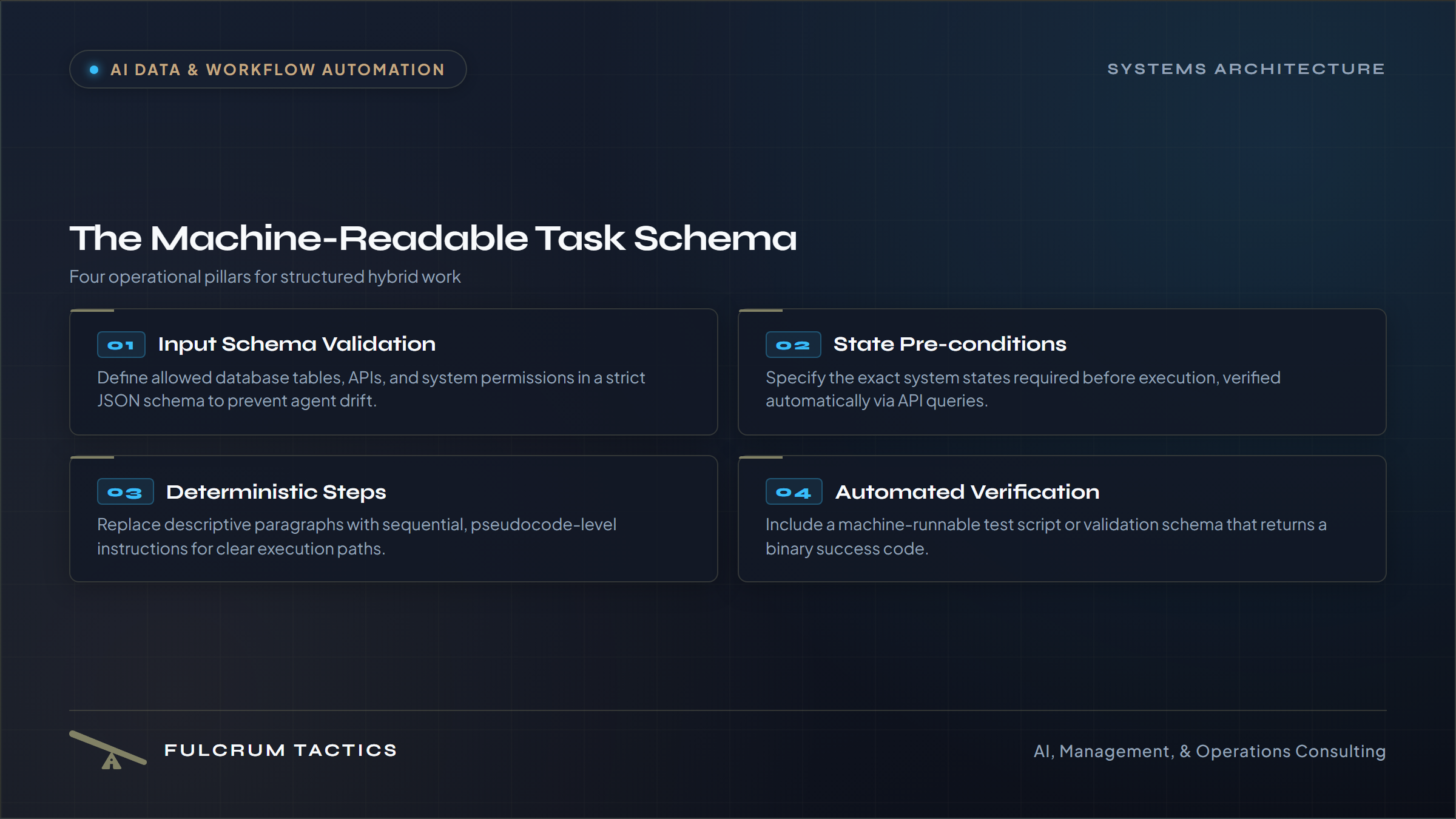
To build a backlog that is executable by both humans and software agents, every task must conform to a strict data contract. This contract replaces open-ended descriptions with four structured blocks:
1. Strict Input Schemas
Define the exact data inputs the agent can access. Do not write "Use the database." Instead, define an input schema in JSON format that specifies the allowed tables, read-only permissions, and API endpoints. This prevents the agent from searching outside the task boundary.
{
  "allowed_tables": ["users", "user_metadata"],
  "query_type": "SELECT",
  "max_rows": 1000
}
2. State Constraints and Pre-conditions
State exactly what must be true before the task begins. For a database cleanup task, the pre-condition is: "The target database replica is synchronized, and the write-ahead log backup is complete." The agent must verify this state via API or CLI query before executing any code. If the pre-conditions are not met, the task aborts immediately.
3. Deterministic Execution Steps
Replace descriptive paragraphs with pseudocode or a sequential list of API calls. If the agent must use a specific Python library or database index, specify it in the task schema. This eliminates the agent's need to guess the optimal implementation path.
steps:
  - step_1: "Run script check_db_lag.py to verify replica lag is under 10 seconds."
  - step_2: "Execute query_inactive_users.sql to extract target IDs."
  - step_3: "Write output to /tmp/inactive_users.csv."
4. Automated Validation Schemas
Every task must include an automated definition of done that a machine can test. This is not a human checklist. It is a validation script, a JSON schema validator, or a unit test suite. The agent executes its work, runs the validation script, and only submits the pull request or database transaction if the validation returns a success code (exit 0).
Rebuilding Your Workflow Pipeline
Transitioning to a machine-readable backlog does not mean human product managers must write JSON schemas all day. Instead, it introduces a three-step workflow pipeline:
- The Human Intent Layer: The product manager or operations lead writes the business requirement in standard prose. They define the business goal, such as "We need to purge unverified trials to save database storage."
- The Schema Translation Layer: A technical lead or a specialized translation agent processes the prose ticket and outputs a structured task payload (YAML or JSON) that adheres to your organization's task schema. This payload is stored in your project management tool via custom API fields. This translation acts as a compiler, turning human intent into machine-executable code.
- The Execution and Validation Loop: The autonomous agent fetches the structured payload via webhook or API request, executes the steps within a sandboxed container, and runs the automated validation. If validation fails, the agent reads the error logs and iterates. If it succeeds, the agent triggers a webhook to notify the human supervisor for final approval.
The Operational Payoff
By shifting to structured task architecture, you build a system where humans and agents operate in their optimal zones. Humans design the business logic and validate the final outputs. Agents execute repetitive, well-defined operations at machine speed.
This architecture reduces task cycle times by over 60% and eliminates the debugging loops that occur when agents try to interpret vague human prose. Stop trying to make your AI models smarter. Make your task data cleaner.