
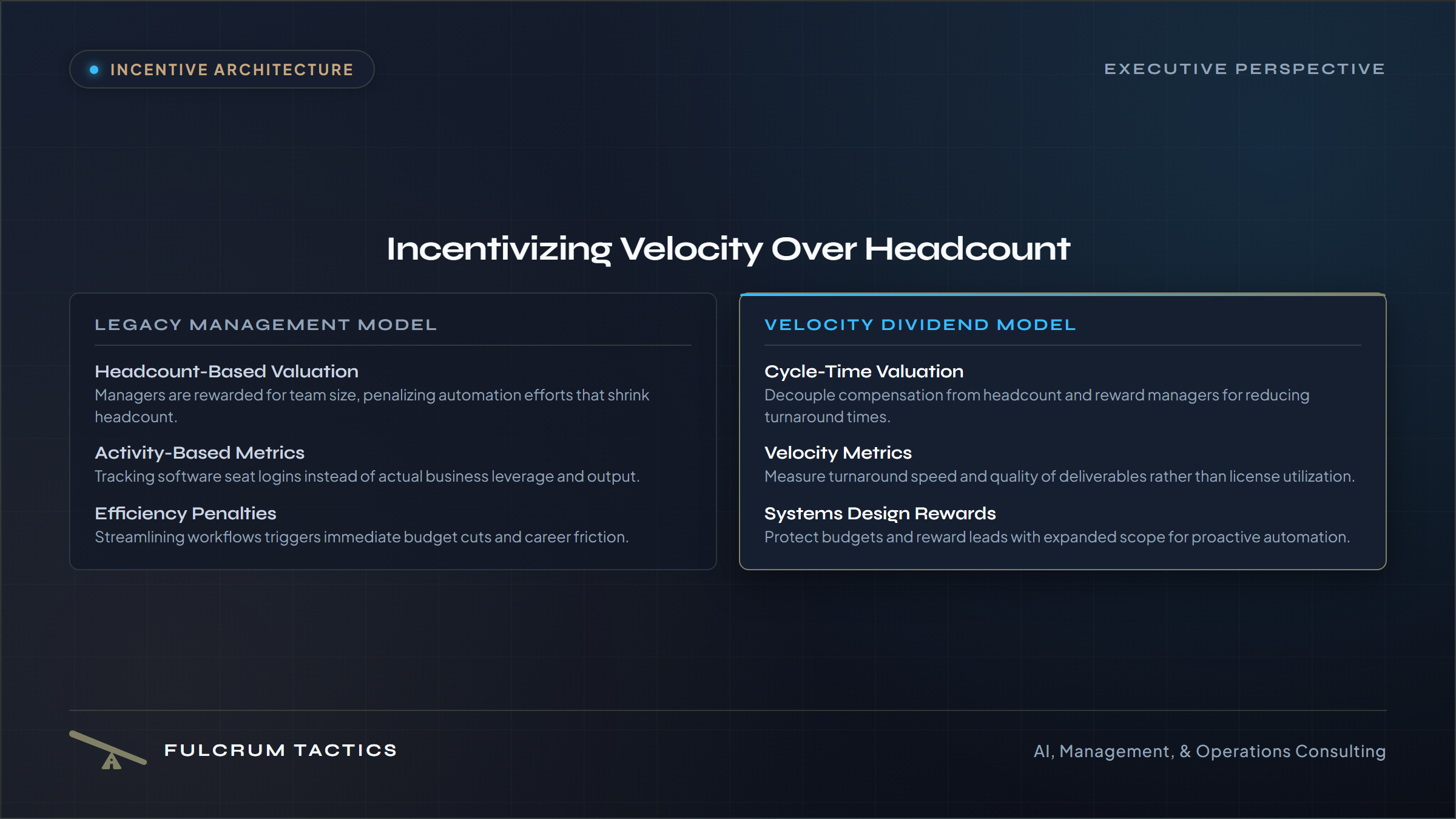
Internal AI rollouts rarely stall because large language models fail to write text or process data. They stall because standard corporate incentive structures unintentionally penalize middle managers for making their teams more efficient.
Over the past two years, leadership teams have spent heavily on software licenses. Early login spikes look promising on executive dashboards. Yet months later, day-to-day operations remain unchanged: turnaround times stay flat, hiring plans remain locked, and team leads quietly return to manual routines.
When executive teams look into this gap, they often blame skill shortages, change resistance, or prompt engineering issues. The real issue is simpler: traditional performance reviews measure a manager's value by the size of their team and the scale of their budget. Asking a department lead to streamline a 10-person task into a 2-person process—without changing how that lead is evaluated—asks them to voluntarily reduce their own corporate footprint.
Solving this adoption bottleneck requires replacing software usage metrics with a Velocity Dividend.
Why Do Traditional Management Incentives Block AI Adoption?
Traditional management incentives block AI adoption because leadership compensation, promotion tracks, and organizational status are historically tied to headcount size and budget scale. When managers use automation to cut task hours, they risk future budget reductions and smaller teams, creating a natural structural resistance to workflow redesign.
Traditional Performance Metrics vs. The Velocity Dividend
┌─────────────────────────┬────────────────────────────┬────────────────────────────┐
│ Dimension               │ Legacy Management Model    │ Velocity Dividend Model    │
├─────────────────────────┼────────────────────────────┼────────────────────────────┤
│ Core Valuation Metric   │ Headcount managed & budget │ Cycle-time reduction       │
│ Primary Success Signal  │ Software logins (WAU/MAU)  │ Turnaround speed & quality │
│ Efficiency Outcome      │ Punished with budget cuts  │ Rewarded with new scope    │
│ Cultural Recognition    │ Late-night firefighting    │ Proactive systems design   │
└─────────────────────────┴────────────────────────────┴────────────────────────────┘
When a team lead uses software to cut an operational process from 80 hours a week down to 10, they face three immediate hurdles under traditional systems:
- Budget Dilution: Lower labor requirements often trigger cuts to the department’s operating budget in the next fiscal cycle.
- Career Friction: Organizational charts often gauge leadership seniority by team headcount. Automation reduces the physical footprint of the team.
- Risk Imbalance: If automated software hits an edge-case error, the manager takes immediate scrutiny. If a manual team makes the same mistake due to fatigue or backlog, it is treated as standard operational friction.
Under these ground rules, managers naturally adopt tools only for surface-level personal tasks (drafting emails, summarizing calls) while keeping core team processes manual.
Why Are Software Seat Licenses the Wrong Way to Measure AI Adoption?
Tracking Weekly Active Users (WAU), prompt volume, or license assignment measures software exposure, not business leverage.
A manager generating hundreds of chatbot queries a week to refine slide decks delivers minimal business value if core team deliverables still take two weeks to clear review. Conversely, a team that sets up a simple script to parse and validate customer data might make only a few automated calls a day, while collapsing a multi-day review process down to five minutes.
Evaluating software rollout by login count is like measuring kitchen productivity by counting how many chefs hold spatulas. Operations leaders need to stop evaluating adoption by software consumption and start evaluating it by workflow speed.
What is the Velocity Dividend Framework?
The Velocity Dividend is an operational framework that evaluates managers on cycle-time reduction, process architecture, and operational throughput rather than team headcount. It aligns individual leadership rewards directly with the speed and reliability of core business deliverables.
Execution Framework:
[Shift to Cycle-Time Metrics] ──> [Protect Manager Compensation] ──> [Reward Process Architecture]- Evaluate Cycle-Time Compression Over Capacity: Standard management tracks capacity—keeping team members busy for 40 hours a week. The Velocity Dividend measures how fast a team delivers finished work. Annual performance ratings should directly reflect turnaround reductions on core tasks, assuming output quality holds steady.
- Protect Compensation and Title Tracks During Efficiency Gains: If a department handles the same workload with 30% fewer labor hours, the manager's compensation and career track must remain fully protected. Leadership should redirect that freed-up time toward higher-value initiatives, expanding the manager's strategic scope instead of shrinking their budget.
- Reward Systems Design Over Crisis Management: Companies frequently praise managers who step in to fix last-minute delays. This framework rewards managers who build systems that prevent bottlenecks from forming in the first place.
How Can Leaders Implement the Velocity Dividend in 90 Days?
Aligning management incentives requires coordinated adjustments across operations, leadership, and finance over three practical phases:
90-Day Implementation Roadmap:
[Days 1–30: Map Baseline Cycle Times] ──> [Days 31–60: Reset Scorecards] ──> [Days 61–90: Reallocate Discretionary Budget]- Days 1–30: Document the Baseline Workflow Map primary deliverables across the department. Record current turnaround times, team handoffs, and manual review points before rolling out new software.
- Days 31–60: Reset Leadership Scorecards Remove login and seat-utilization stats from manager reviews. Replace them with specific targets to reduce turnaround times on key workflows by a defined percentage without increasing error rates.
- Days 61–90: Connect Budgets to System Redesign Tie future project allocations to workflow improvements. Managers who deliver verified time savings on core deliverables receive first access to new project resources and team development opportunities.
Software simply accelerates your existing operating model. When you align manager reviews with turnaround speed rather than headcount preservation, team leads shift from managing capacity to actively building more efficient workflows.
🔗 Ingested Source Material & References
- [McKinsey Insights] AI fluency: The next foundation of US economic competitiveness
AI is advancing faster than organizations can adapt. Reaching the next productivity frontier will depend on workers across the economy acquiring the needed habits and skills....
- [McKinsey Insights] Is the AI productivity story at a turning point?
Stanford economist Erik Brynjolfsson reveals where we stand on the J-curve, how leaders can accelerate progress and create new value, and what gives him hope—and keeps him up at night....
- [McKinsey Insights] Bayer’s Sai Jasti on driving productivity in R&D with data science and AI
Sai Jasti, Bayer’s senior vice president and head of data science and AI, on how the company is transforming its workflows and embedding AI in research and development to meet ambitious productivity g...
- [HBR Technology] Customer strategy
...
- [HBR Technology] Organizational decision making
...