
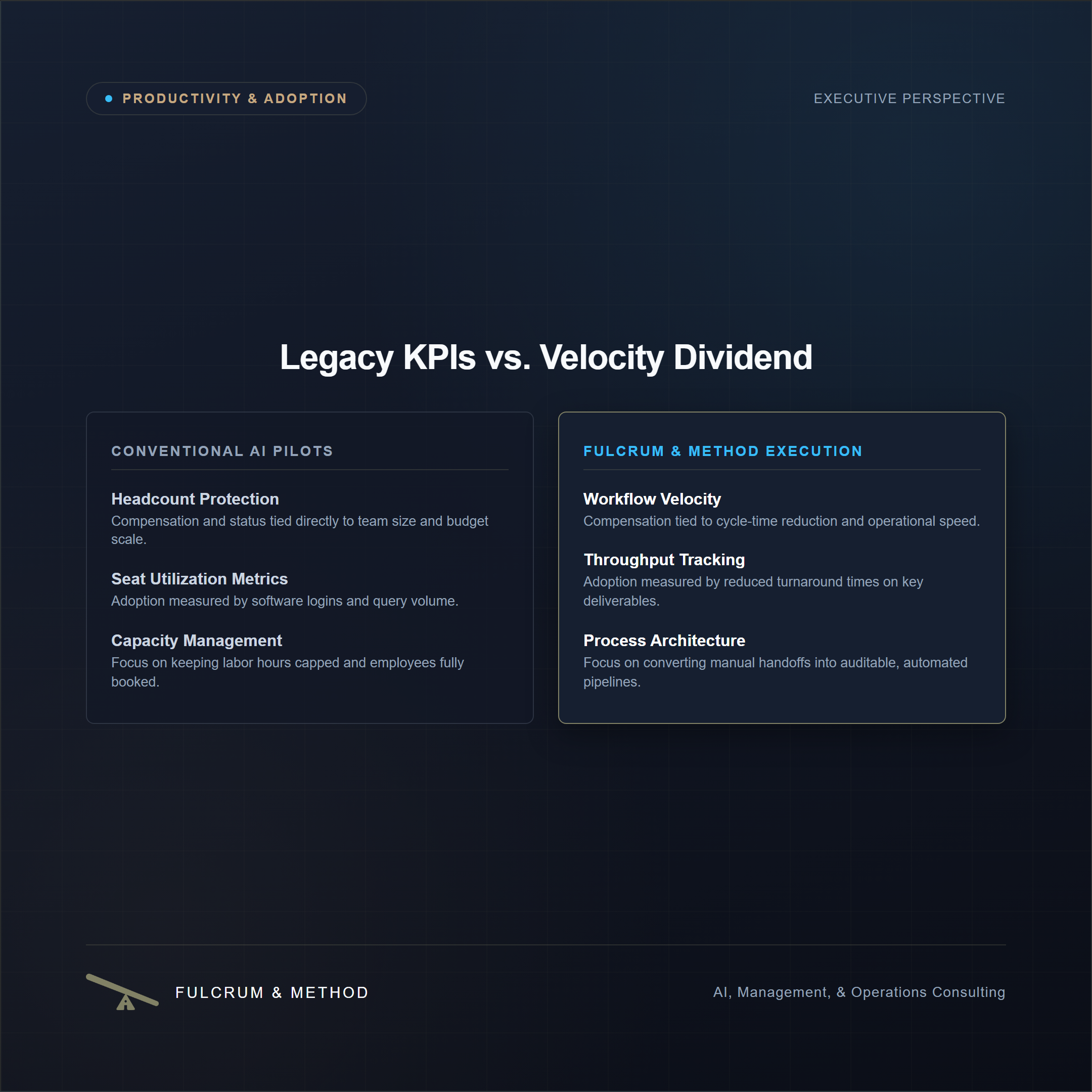
Enterprise AI rollouts do not stall because large language models fail to synthesize text or generate code. They stall because the average corporate incentive structure actively punishes middle managers for making their teams more efficient.
Over the past two years, boardrooms have funneled millions into enterprise AI licensing. Executives point to high login counts during pilot weeks and declare early victories. Yet six months later, core operating metrics remain unchanged: turnaround times on key deliverables are static, headcounts remain locked, and team leads quietly default to legacy manual processes.
When operations executives investigate this disconnect, they typically blame change fatigue, skill gaps, or poor prompt engineering. The actual cause is structural. Middle management operates under a traditional performance evaluation framework that equates organizational importance with headcount size and budget control. Asking a director to use AI to condense a 10-person workflow into a 2-person process—without changing how that director is evaluated—is asking them to voluntarily diminish their enterprise status.
To break this bottleneck, leadership must abandon vanity usage metrics and restructure performance incentives around a Velocity Dividend.
The Incentive Trap: Why Headcount Protection Trumps Automation
In most enterprise environments, compensation bands, career progression, and organizational status are tied directly to two metrics: total headcount managed and budget overhead controlled.
This framework creates an unintended defense mechanism against workflow automation. When a team lead successfully integrates AI to compress a core operational task—reducing labor hours from 80 hours per week down to 10—they encounter immediate structural friction:
- Budget Dilution: If labor requirements decrease, line-item budgets for the following fiscal year are reduced.
- Career Stagnation: Org charts measure senior management capability by team scale. Automation shrinks the physical size of the team.
- Risk Asymmetry: If an automated pipeline produces an edge-case error, the manager takes direct blame. If a manual team produces the same error through human delay, it is written off as standard operational friction.
Under these conditions, a rational manager will adopt AI tools only for surface-level personal tasks (editing emails, summarizing meeting transcripts) while deliberately shielding core team workflows from structural redesign.
Moving Past Vanity Metrics: The Enterprise License Illusion
To track progress, central IT and transformation offices rely heavily on dashboard metrics provided by SaaS vendors: Weekly Active Users (WAU), Seat Utilization Rates, and Prompt Query Volume.
These metrics measure tool exposure, not economic value. A manager who issues 500 chatbot queries a week to format internal slide decks creates zero enterprise leverage if the core department outputs still take 14 days to clear quality control. Conversely, a team that builds a single deterministic Python script wrapped with targeted LLM data-parsing might run only 10 API calls a day—yet compress a multi-day reconciliation workflow down to five minutes.
Measuring AI adoption by seat count is equivalent to measuring factory efficiency by counting how many workers own safety goggles. Operations executives must stop evaluating AI deployment by software consumption and start evaluating it by workflow velocity.
The Velocity Dividend Framework
To align middle management incentives with organizational leverage, operations executives must redesign compensation and performance reviews around three operational shifts.
1. Shift Target Metrics from Capacity to Cycle Time Traditional managers are rewarded for maximizing capacity utilization—keeping every employee logged in and billable for 40 hours a week. The Velocity Dividend model replaces capacity tracking with cycle-time compression on core business deliverables.
A manager's annual performance rating should directly reflect the percentage reduction in end-to-end turnaround time for primary outputs, provided quality standards are maintained.
2. Protect Manager Compensation from Efficiency Reductions If a department manager leverages workflow automation to execute the same volume of work with 30% fewer labor hours, that manager’s compensation, title track, and organizational authority must be explicitly protected.
Instead of penalizing the manager with budget cuts, leadership must reallocate the saved capacity toward higher-value strategic projects or revenue-generating activities, maintaining the manager's oversight over that expanded operational scope.
3. Reward Process Architecture Over Execution Firefighting Corporate culture routinely celebrates managers who put out fires—staying late to manually fix operational delays. The Velocity Dividend framework shifts rewards to managers who design systems that prevent fires from occurring.
Quarterly bonuses should be tied to workflow documentation and automation architecture: Did the manager successfully convert a tacit, human-dependent process into an auditable, hybrid workflow?
Operationalizing the Shift: A 90-Day Execution Roadmap
Realigning incentives requires operational changes across HR, operations, and finance. Executives should execute this transition through three distinct phases:
- Phase 1: Identify the Baseline Cadence (Days 1–30)
- Phase 2: Establish the Velocity Benchmark (Days 31–60)
- Phase 3: Tie Capital Allocation to System Redesign (Days 61–90)
Directing Leverage Where It Matters
AI is an amplifier of underlying systems architecture. Deploying advanced software into an organization with misaligned middle management incentives only accelerates existing operational inefficiencies.
When operations leaders shift performance metrics from headcount retention and software usage to workflow velocity and cycle-time compression, middle managers cease to be adoption bottlenecks. They become the primary architects of enterprise efficiency.
🔗 Ingested Source Material & References - [McKinsey Insights] AI fluency: The next foundation of US economic competitiveness > AI is advancing faster than organizations can adapt. Reaching the next productivity frontier will depend on workers across the economy acquiring the needed habits and skills....
- [McKinsey Insights] Is the AI productivity story at a turning point?
- [McKinsey Insights] Bayer’s Sai Jasti on driving productivity in R&D with data science and AI
- [HBR Technology] Customer strategy
- [HBR Technology] Organizational decision making