
Bottom Line Up Front (BLUF)
Individual generative AI seat licenses waste cash, isolate team data, and fail to build enterprise value. Switching to a centralized, API-driven team workspace drops your software expenses by up to 80%, protects your proprietary workflow data, and converts a recurring operating expense into an owned business asset. For a 50-person firm, this transition can add over $80,000 back to EBITDA over three years while creating a high-value, transferable capital asset.
The Financial Bleed of the Per-Seat SaaS Tax
Many middle-market businesses manage generative AI adoption by letting employees sign up for individual accounts. Employees expense $20 or $30 monthly charges for ChatGPT Plus, Claude Pro, or specialized writing assistants.
This approach creates three immediate problems for operating margins and firm valuation:
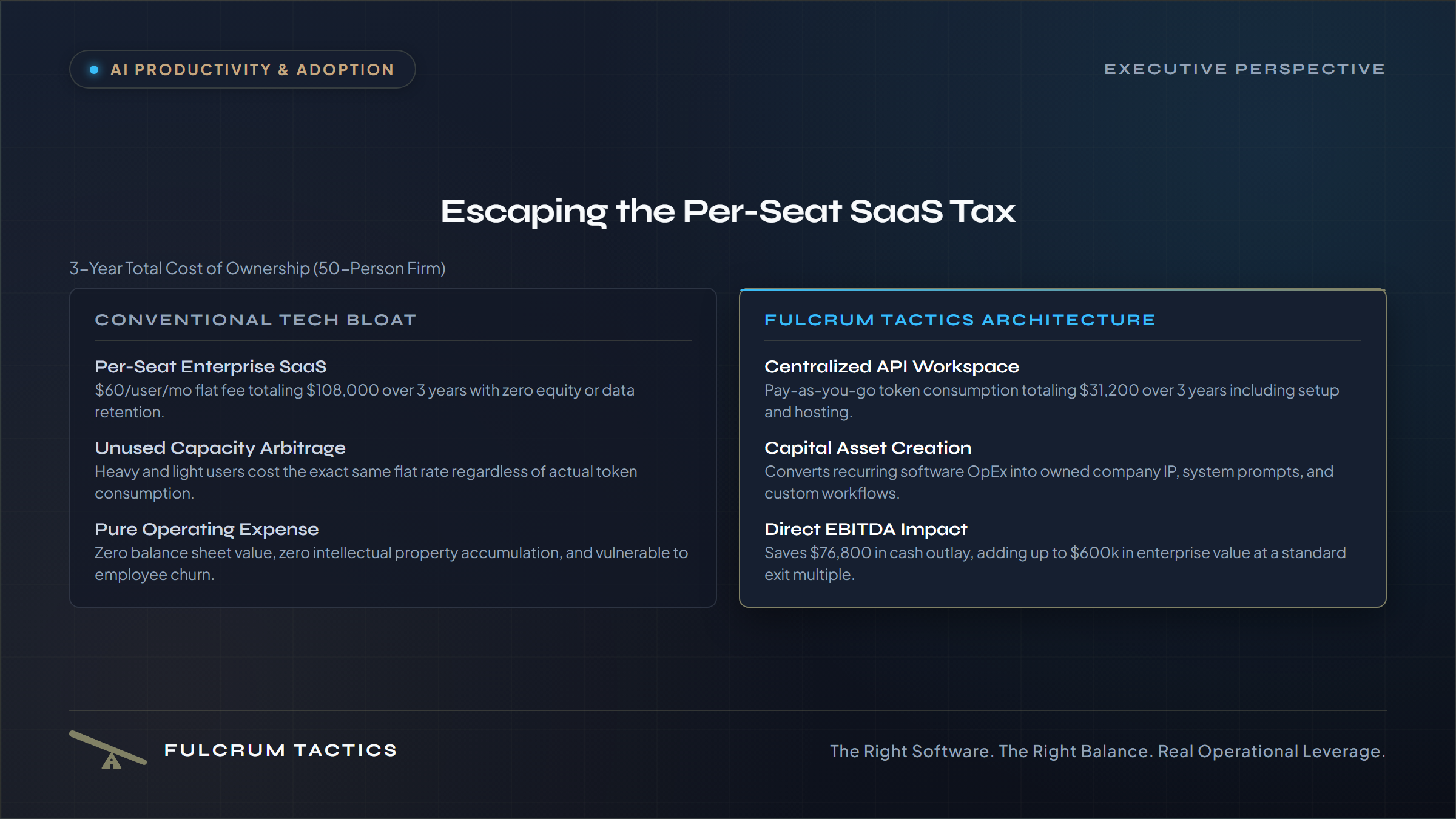
- Unused Capacity Arbitrage: Under per-seat SaaS models, you pay a flat rate regardless of actual use. A marketing writer might consume millions of tokens of context monthly, while an operations associate might run three queries a day. You pay $20 per month for both, overpaying for the operational reality.
- Operational Knowledge Loss: When an employee leaves, their chat history, custom system prompts, and structured workflows disappear with their account. The business loses the cumulative operational learning of its staff.
- Runaway OpEx with Zero Equity Value: SaaS subscriptions represent pure operating expenditure. You build no equity in the software. The moment you stop paying the monthly fee, your access, historical data, and operational tooling evaporate.
For a firm with 50 knowledge workers, individual licenses cost roughly $1,000 to $1,500 per month. If you step up to enterprise plans, that cost often doubles. This recurring cost drains cash runway without generating any intellectual property or capital assets for your balance sheet.
Architecture of an Owned Multi-Player Workspace
Instead of renting access from consumer interfaces, your firm can deploy an owned, multi-player workspace. This architecture separates the user interface from the underlying model providers.
[ Team Members ] ---> [ Owned Web UI (LibreChat / Open WebUI) ]
                             | (Central Admin & Logging)
                             v
                     [ API Gateways ] ---> OpenAI (GPT-4o)
                     (Pay-as-you-Go)  ---> Anthropic (Claude 3.5 Sonnet)
                                      ---> DeepSeek / Open-Source Models
The stack is straightforward to deploy and maintain:
- The Frontend Interface: Use open-source, enterprise-grade web interfaces like LibreChat or Open WebUI. These applications mimic the consumer experience of ChatGPT or Claude but run on your own servers (such as AWS, Google Cloud, or a secure virtual private server).
- The API Layer: Connect the interface directly to the developer API endpoints of OpenAI, Anthropic, or run open-source models on your own instances. You pay only for the exact volume of text (tokens) processed.
- The Database: Store chat history, system prompts, and custom files in an internal PostgreSQL database.
- Access Control: Connect the workspace to your existing identity provider (Google Workspace or Microsoft Entra ID). You control access from a single admin panel.
This configuration gives your team access to every major model from a single interface. Employees switch between GPT-4o, Claude 3.5 Sonnet, and open-source options in the same chat window, while your data remains inside your secure cloud boundary.
Operating Metrics: Calculating the 3-Year TCO
The financial difference between per-seat licensing and an API-driven workspace is substantial. The comparison below outlines the three-year total cost of ownership (TCO) for a 50-person organization.
| Cost Category | Scenario A: Per-Seat Enterprise SaaS ($60/user/mo) | Scenario B: Centralized API-Driven Workspace |
|---|---|---|
| Year 1 Setup & Dev | $0 | $6,000 (One-time deployment & configuration) |
| Year 1-3 Maintenance | $0 | $200 / month ($7,200 total) |
| Hosting & Infrastructure | $0 | $150 / month VPS ($5,400 total) |
| Subscription / API Costs | $36,000 / year ($108,000 total) | $350 / month avg. API spend ($12,600 total) |
| Total 3-Year TCO | $108,000 | $31,200 |
| Net Savings (EBITDA Impact) | — | $76,800 saved |
API pricing is highly favorable for buyers. Processing 1,000 tokens (roughly 750 words) on a leading model costs a fraction of a cent. Across a standard 50-person company, the average actual API utilization rarely exceeds $350 to $500 per month, even with heavy usage.
By building your own portal, you save over $75,000 in three years. That money flows directly to your bottom-line EBITDA. At a standard 6x to 8x exit multiple, that additional EBITDA adds $450,000 to $600,000 in enterprise value.
Turning Software Expense into a Balance Sheet Capital Asset
When you deploy a centralized workspace, the code, the database, and the prompt libraries belong to your company. You can capitalize the initial development and deployment costs of this system, converting what would have been software OpEx into a capital asset (CapEx).
More importantly, your firm starts accumulating proprietary data. The workspace acts as a central repository for:
- System Prompts: Standardized templates that write reports, draft client emails, analyze spreadsheets, or audit code in your exact company style.
- Context Libraries: Secure, internal knowledge bases that allow models to reference your historical proposals, operating procedures, and brand guidelines.
- Fine-Tuning Data: High-quality chat histories that can train smaller, cheaper models for your specific business processes down the line.
An acquirer or investor looks at a stack of consumer ChatGPT subscriptions as an easily replaceable operational expense. They look at a central, custom-tailored internal platform containing your company's operational recipes as highly valuable intellectual property.
A 30-Day Transition Playbook
Moving your team from scattered subscriptions to an owned workspace requires minimal operational friction.
Phase 1: Infrastructure Setup (Days 1–10)
- Provision a virtual private server on your cloud provider of choice.
- Deploy LibreChat or Open WebUI using Docker.
- Set up API accounts with Anthropic and OpenAI. fund the accounts with a starting balance of $100 each.
- Configure Google Workspace or Microsoft Entra ID for Single Sign-On (SSO).
Phase 2: Pilot and Prompt Import (Days 11–20)
- Bring five power users from different departments into the workspace.
- Have them import their most frequently used prompts and document templates into the shared workspace library.
- Test billing consumption rates to establish a baseline.
Phase 3: Migration and Offboarding (Days 21–30)
- Roll out access to the entire company.
- Block expensing of individual AI tools.
- Run a one-hour training session on how to use the shared platform, highlighting the ability to switch between Claude and GPT-4o instantly.
- Cancel existing individual subscriptions to recover cash flow immediately.