
Most content operations run into a basic bottleneck: they treat writing ideas and formatting them for specific platforms as the exact same task.
When a company decides to expand its presence—branching out from a company blog to LinkedIn, X, video scripts, and client newsletters—the common reaction is to hire. Teams bring on separate copywriters, video editors, and social media managers for each channel.
This approach creates a linear cost trap. To double your channel coverage, you have to double your payroll or agency retainers. The cost to adapt an existing insight for a new platform stays high, while organic reach remains unpredictable.
Expanding your reach without ballooning production costs requires separating your core business insights from platform-specific formatting. That workflow is called a Semantic Media Layer (SML).
What is a Semantic Media Layer?
A Semantic Media Layer (SML) is a content operations system that decouples raw subject matter expertise from channel formatting by storing core insights in a structured JSON schema. This machine-readable record allows automated scripts to generate platform-specific drafts—such as LinkedIn posts, newsletters, and video scripts—without re-interviewing experts.
Separating Core Insights from Channel Presentation
┌────────────────────────────────────────────────────────────────────────┐
│                        Raw Expert Knowledge                            │
│           (Whitepapers, Recorded Calls, Diagnostic Frameworks)         │
└───────────────────────────────────┬────────────────────────────────────┘
│
▼
┌────────────────────────────────────────────────────────────────────────┐
│                      Semantic Media Layer (SML)                        │
│           Structured JSON: Thesis | Evidence | Frameworks | Quotes      │
└───────────────┬───────────────────┼────────────────────┬───────────────┘
│                   │                    │
▼                   ▼                    ▼
[LinkedIn Posts]      [X Breakdowns]     [60s Video Scripts]
When writers create directly for one platform, ideas get locked inside temporary formats. A strong LinkedIn post is difficult to repurpose automatically into an email newsletter because the core points are tangled up with platform hooks, character limits, and feed conventions.
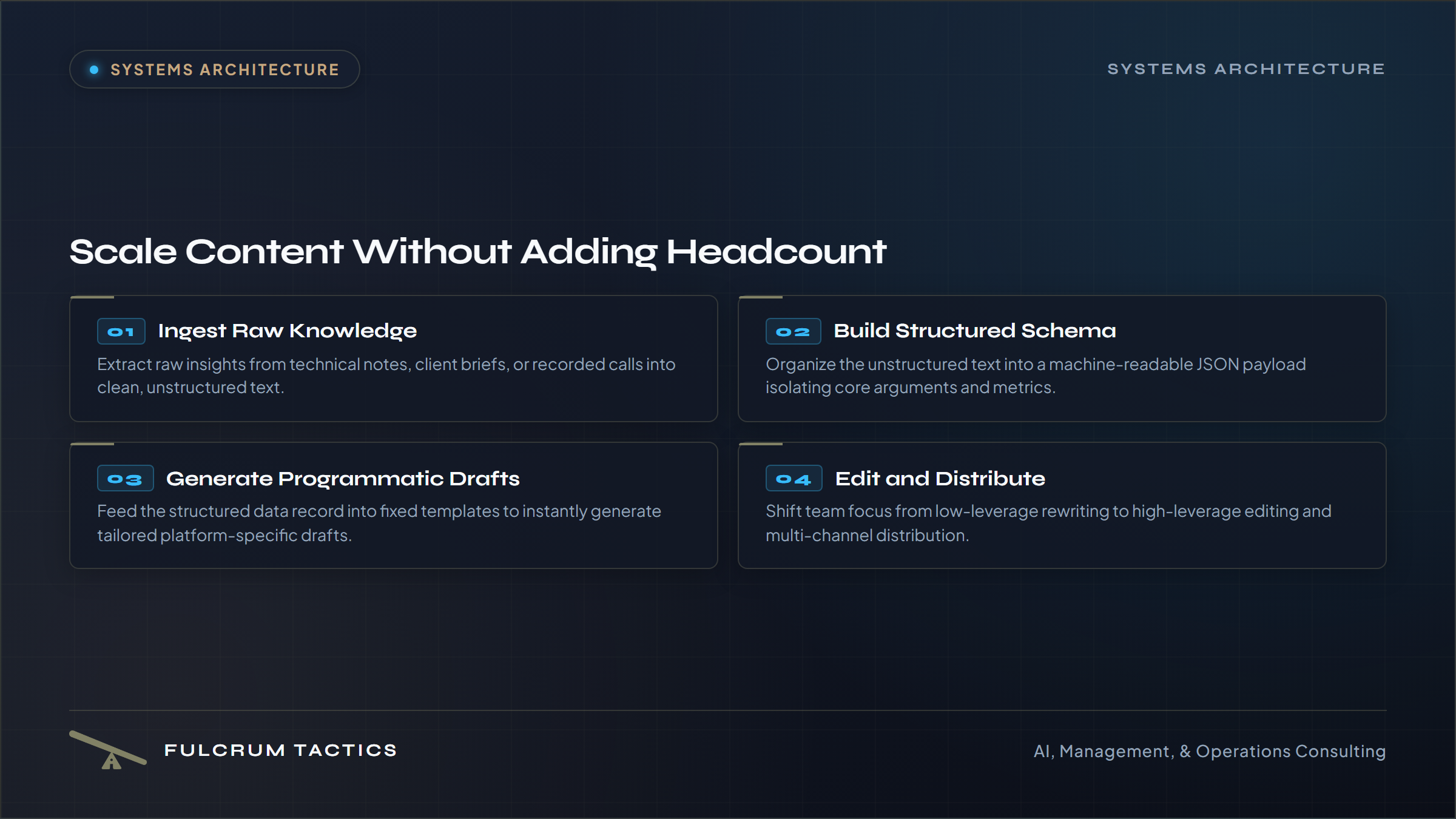
By setting up a Semantic Media Layer, you extract raw knowledge from your team once and save it in a clean, platform-neutral structure. Once structured, that single data record can generate dozens of tailored drafts across multiple channels at negligible marginal cost.
What are the 3 Tiers of a Semantic Media Architecture?
Building a Semantic Media Layer does not require an enterprise software buildout. It runs on a straightforward, three-tier data pipeline:
- The Ingestion Tier: Gather raw material from technical briefings, customer teardowns, or whitepapers. Simple transcription tools and text parsers clean the text, stripping out conversational filler to isolate key operational takeaways.
- The Semantic Schema Tier: Process the clean text with an LLM API configured with strict JSON schemas. The script extracts specific fields:
• Core Thesis: The primary operational insight or contrarian argument.
• Supporting Points: 3 to 5 distinct sub-arguments proving the point.
• Verified Evidence: Exact benchmark figures, case metrics, and clear source attributions.
• Proprietary Definitions: Clear explanations of your firm's named frameworks.
• Direct Quotes: Key statements from the practitioner. - The Programmatic Generation Tier: Feed the structured JSON payload into tightly constrained, platform-specific templates. Because the system formats verified data rather than generating ideas from scratch, hallucinations drop to zero and brand voice remains consistent.
How Does a Semantic Media Layer Change Content Production Economics?
Linear Production vs. Semantic Media Operations
┌─────────────────────────┬────────────────────────────┬────────────────────────────┐
│ Metric                  │ Legacy Copywriting Model   │ Semantic Media Layer Model │
├─────────────────────────┼────────────────────────────┼────────────────────────────┤
│ Production Method       │ Manual drafting per channel│ Automated schema extraction│
│ Output per Source Asset │ 3–5 platform variations    │ 20–30 tailored drafts      │
│ Human Labor Focus       │ Formatting & rewriting     │ Review, refinement & polish│
│ Turnaround Time         │ 2 to 3 weeks               │ Under 24 hours             │
│ Marginal Cost per Draft │ High (Linear labor growth) │ Near zero (API calls)      │
└─────────────────────────┴────────────────────────────┴────────────────────────────┘
In a traditional model, turning one research paper into a full multi-channel campaign often requires 30 to 40 hours of manual copywriting, cross-checking, and layout adjustments across several team members.
Under a semantic workflow, ingestion and structured rendering take minutes. A senior editor then spends two to three hours reviewing and polishing the outputs before scheduling. The team moves away from low-leverage formatting work and focuses entirely on editorial judgment and distribution strategy.
How Do You Build a Semantic Pipeline in 3 Steps?
You can test and deploy this operational structure without disrupting your existing marketing rhythm:
- Define your core data fields: Select 5 to 7 structural elements that capture your firm's distinct intellectual capital (such as core problem, root cause, named framework, and tactical steps).
- Set up a single extraction script: Write a basic Python script using structured JSON outputs to parse interview transcripts into your predefined schema.
- Keep an editor at the approval gate: Never automate publishing directly to your feeds. Keep a human editor firmly in charge of final review to preserve voice, tone, and tactical nuance.
As new social channels and formats emerge, successful operations will not depend on large copywriting teams. They will depend on clean operational pipelines that deploy proprietary expertise wherever buyers gather.
🔗 Ingested Source Material & References
- [Inc. Magazine] This New Jack Dorsey-Backed Social Media Platform Is Bringing Back The Magic of Vine. Founders Should Jump In Early
DiVine is bringing back Vine’s six-second magic. It’s an opportunity for founders to gain digital leverage fast.
...
- [Inc. Magazine] 65 Percent of Small Businesses Have a Problem That Can Quietly Kill a Sale Before Closing
Tax-ready books are not the same as buyer-ready financials, and the gap can cost founders real money.
...
- [Inc. Magazine] Founders Think the Letter of Intent Locks In the Deal. It Often Locks In Their Weakness
Founders often lose leverage after the LOI. Guard against retrades, weak process, diligence dips, hidden problems, and fuzzy walk-away terms.
...
- [BCG AI Insights] Risk Management and Compliance
As agentic systems turbocharge the pace of financial fraud and scams, banks must leverage AI to ready their defenses....
- [Bain AI Insights] Healthcare & Life Sciences
...