
Bottom Line Up Front (BLUF)
Enterprise customer experience (CX) systems fail when middle-tier orchestration systems discard session state during multi-agent handoffs. The issue is not conversational competence; it is state preservation. When a user moves from triage to billing, the context window resets or gets corrupted. To eliminate this state-loss tax, engineering teams must stop relying on LLM memory. Instead, they must implement an externalized, schema-enforced state database that acts as a single source of truth across all agent transitions.
The Mechanics of the State-Loss Tax
In a multi-agent architecture, each agent is a specialized LLM wrapper configured with specific system prompts and toolsets. A user begins their session with a triage agent, authenticates, explains their billing discrepancy, and is then transferred to a billing specialist.
During this transfer, the system must hand off the conversation. Developers often attempt this handoff using one of two flawed methods: 1. Context Window Stuffing: Appending the raw chat history of Agent A to the system prompt of Agent B. 2. Prompt-Based Summarization: Asking Agent A to write a summary of the interaction, then injecting that summary into Agent B's system prompt.
Both approaches fail at scale. Context window stuffing degrades latency, increases token costs, and introduces retrieval noise. Prompt-based summarization relies on the LLM to identify critical variables, which leads to hallucinated transaction IDs, lost account numbers, and forgotten user intents. This is the state-loss tax: the operational drag, API cost overhead, and customer frustration caused by broken context handoffs.
Why Middle-Tier Orchestration Fails
The fault lies in treating conversational memory as unstructured text. An LLM context window is temporary, volatile storage. It is not a database.
When an agent handoff occurs, the receiving agent requires structured data to execute its functions. If a billing agent needs a validated account ID, a confirmed invoice number, and an authenticated session token, extracting these from a raw chat transcript is unreliable. If the extraction fails, the agent must ask the customer to repeat information they already provided.
To achieve deterministic handoffs, you must separate the conversational interface from the underlying session state. The conversation is merely the input mechanism; the state is the structured record of truth.
The Four-Step Deterministic Handoff Architecture
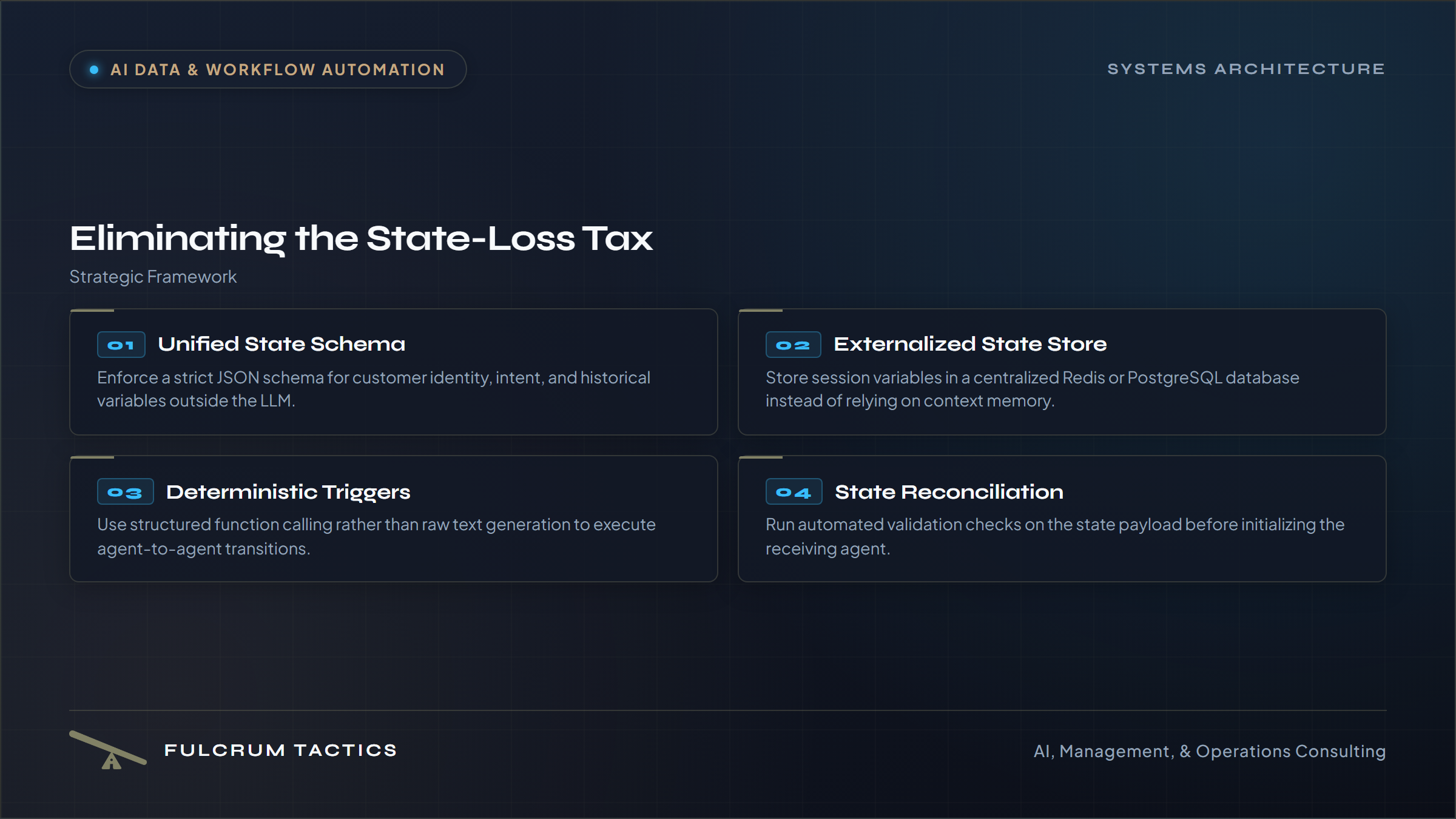
To build a system that preserves state across any number of agent transitions, implement the following four-tier architecture.
1. The Unified State Schema
Define a single, immutable JSON schema that governs the entire customer session. This schema must exist outside the LLMs. It is maintained in a centralized repository and versioned like database migrations.
A basic schema contains: Identity State: Authenticated user ID, verification level, and session tokens. Intent State: The primary goal and sub-intents. Entity State: Extracted variables such as transaction IDs, amounts, and dates. Routing State: The current active agent, previous agents visited, and handoff history.
2. Centralized State Store (Redis/Postgres)
Do not store session state in the LLM's memory or the client-side application. Use a fast, key-value store like Redis or a document store like PostgreSQL with JSONB columns.
Every agent interaction reads from and writes to this centralized store via a strict API. When Agent A extracts an account number, it writes that value directly to the state store. When Agent B starts, its system prompt is initialized with the current values read directly from the state store, not a raw transcript.
3. Deterministic Handoff Triggers (Function Calling)
Never let an LLM decide how to route a user using raw text output. Use structured function calling (tool use) to trigger handoffs.
Define a transition tool that requires specific parameters, such as target agent and required state updates. The orchestrator intercepting this function call validates the payload against the JSON schema before executing the transfer. If the payload is invalid, the handoff halts, and the current agent is prompted to collect the missing data.
4. State Reconciliation and Validation Engine
Before the orchestrator initializes the target agent, a validation engine runs. This engine acts as a gateway. It checks if the minimum required state variables for the target agent are present in the centralized store.
For example, the billing specialist agent requires a verified identity flag. If the validation engine detects that the verification flag is false, it overrides the routing logic, redirects the user to the authentication module, and preserves the billing intent in the state store for execution post-verification.
Real-World Performance Impact
In a 2023 study on multi-agent conversational systems published in the Journal of Artificial Intelligence Research, researchers found that structured state tracking reduced task-failure rates by up to 40% compared to systems relying purely on prompt-based context accumulation. Furthermore, externalizing state reduces token consumption per turn by eliminating the need to re-feed massive chat histories into every downstream agent.
By treating session state as structured data and agent handoffs as database transactions, you eliminate the state-loss tax. Your conversational agents stop guessing, stop repeating questions, and start executing.